Let's turn the camera lens into a telescope/monocular
When we went to visit the elders in the family last weekend, I rummaged through the cupboards where my old belongings were kept. I found the binocular I had scraped together to buy back in middle school. I’d saved up for a long time and then, with the help of an acquaintance, found them in the Russian second-hand markets. They were old even back then. Now they’re really worn out. The diopter doesn’t work. The axis is misaligned. It made me sad. But it hasn’t lost that old leather smell on the strap. The moment I touched it, it instantly reminded me of the excitement I felt on the very first day. I used to carry it everywhere for years. Making the far feel near seemed magical.
Even a middle-of-the-road binocular like that was incredibly useful for astronomy. It could make easy targets visible—certain nebulae, Andromeda, and four of Jupiter’s moons.
Now the wheel has turned, and it’s my curious little daughter’s turn. The day I bought my new wooden tripod, she commandeered the old one. I couldn’t say no, so I said, “Well then, let’s make you a monocular for this tripod.” I sorted out the lens and adapter on eBay, and until the mailman brought them she asked about her monocular nearly every day. Today she’s finally happy. She’s parading her present around and showing it to everyone. She even wanted to take it to her school, to kindergarten.
Monocular / Telescopic Converter
There are adapters with this English name. We could call them a monocular or telescope adapter. You’ll remember the concepts of objective and ocular (eyepiece). Devices like microscopes and telescopes have two different lens groups. The part you look directly into is called the ocular (eyepiece). That’s this part. The other component is the objective you already know.
What does the ocular do? Why does it exist?
The light rays coming from the objective travel so they converge at the lens’s focal distance—just like with a magnifying glass. A lens forms a sharp image on a sensor, but not in our eye. Because our eye has an extra lens. That lens interferes! When the eye’s lens refracts and focuses already-focused rays again, we can’t see sharply. That’s why we need another lens to bring those rays to an angle our eye can accept. The ocular lens harmonizes the optics with the eye. Also, the ocular’s focal value affects magnification by setting the angle of the light reaching the eye to its own value.

Telescope adapters must not be that popular, because they’re sold at reasonable prices. If you want to buy new, there aren’t many options and they’re pricey. But older ones sometimes go for scrap prices. It’s possible to find them for every mount on the market. Especially for mounts that aren’t much used anymore, both the lens and the adapter can be very cheap.

When I set out, I saw different models like these and bought one bayonet adapter for my daughter (M42) and one for my own lenses (Pentax PK). The Pentax one is original Asahi Pentax, so the optical and build quality are a bit higher. They also added a near-far adjustment at the eye piece that works by turning. This adjustment is actually a “diopter adjustment.” Its main purpose is to allow people who wear glasses to get a sharp image with their glasses off. But if we play with it, we can focus much closer than the lens’s minimum focusing distance. In short, a wonderful device.
Now for lens selection
Tokina 80–250mm Autozoom f/4.5
Once the adapter part was sorted, I needed to find an M42-mount zoom lens. I chose M42 as the bayonet because, again, they’re not much preferred and are therefore very affordable. I looked for two things in terms of features: a wide zoom range that could reach as high as possible, and a built-in tripod collar. Because it will be heavy to hand-hold, and since it will magnify a lot, handheld use will be very shaky.
Telescope adapters generally use a 10 mm lens. When calculating magnification, the two lenses are compared by ratio. So if we use the lens at 80 mm, we get 80/10 = 8×; if we set it to 250 mm, we get 250/10 = 25×. What exactly those X’s are referenced to, I don’t know. It’s not exactly relative to the naked eye. Because if a ~35 mm lens is used with a telescope adapter, it feels just like looking with the naked eye. In other words, it doesn’t magnify at all. If 35/10 = 3.5× magnification, that would mean we already see the world at 3.5×! :)
There were lots of candidate lenses. I tracked them for a while to get a feel for average prices. A few weeks later I bought a very clean-looking Tokina 80–250 mm that caught my eye at that moment. Prices are really reasonable. The postage costs more than the lens itself.
Customs must have been confused too. They seized the lens and called me in for inspection. They came out with wise sayings like, “Come on, these are the most expensive things!” Anticipating trouble, I had brought along an old film Zenit body to prove the lens wasn’t a modern product. I mounted the lens on the body right there to show it belonged. After interesting comments like “Well then, is this the biggest one?” they were convinced and handed the lens over without extra charges. I took it home.

Since the lens had a tripod collar, we immediately mounted it on the old Benro. Once we attached the adapter to the back of the lens, our monocular was ready. We practically raced over who would do the first observation, the little one and I, and I won!
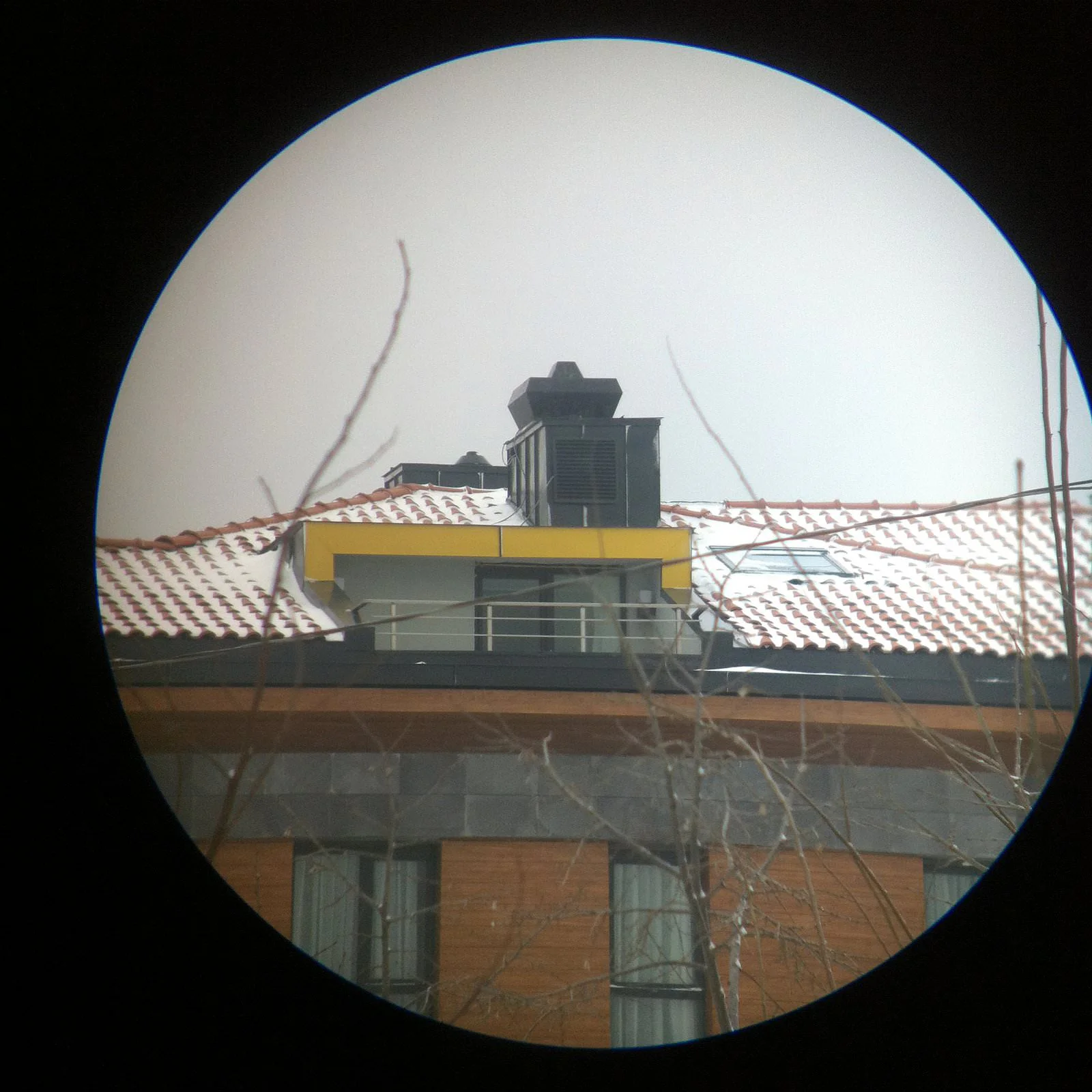
It’s actually a bit hard to put into words what you see and how it looks. But so as not to leave you hanging, I did my best and pressed a phone up to the eyepiece and took photos. When you look through the monocular with your eye, it isn’t like these sample photos. The image doesn’t gather in a circular area in the middle; it’s much wider and much sharper, as it should be when looking through a normal binocular.
Because the phone lens couldn’t get close enough to the ocular lens, the image stayed circular in the center in the shots. Also, today was a very snowy, dark day in Istanbul. Due to the precipitation and low light, the phone camera struggled a lot. At the time of writing, phones didn’t have very powerful cameras. Since I had to hold the phone by hand, I struggled especially at high magnifications. And because it was freezing outside, I didn’t go out. I shot through double-pane glass. The dust and reflections on the glass affected sharpness. Anyway, as you can guess, I didn’t do a great job.
There are adapters made solely for this kind of shooting. They let us attach our camera to the ocular (telescope or binocular). But I don’t have one yet. Anyway, just know that it looks much better to the eye.
Shooting done through an eyepiece like this is called “digiscoping.” People who want to photograph birds sometimes use a telescope together with this method.
Since the lens works between 80 mm and 250 mm, you can nicely zoom in and out with the zoom ring. By changing the aperture, we get a chance to play with light and depth of field. I did the shots with the Tokina at f/11. f/11 is the aperture value at which this lens produces its sharpest image.
Let’s look at our scene first. When I shot with the phone, the view was like this:

I picked the building across the way as the target. We’ll look at the marked area at different focal lengths. First I set the lens to 80 mm.

80 mm resembles the magnification you get from regular binoculars. It’s quite suitable for general landscape viewing. Shake isn’t very noticeable. It can be used handheld comfortably. Now let’s look at 250 mm.

Now that’s what I call magnification! We can see distant details. But holding it in your hands really tires the eyes. It shakes a lot. At this magnification you need to use a tripod. Once the lens is stabilized, the image is great. I was impressed.
Handheld monocular
Telephoto zooms are big and heavy. If we want a handheld monocular to toss into our camera bag, the value I’d recommend is 135 mm. The magnification power is good, and in terms of shake it’s very suitable for handheld use. Plus, the size is reasonable and it’s easy to carry. Friends who do birding and nature photography could go with a solution like this if they don’t already have binoculars.

The K-series SMC 135 mm f/2.5 is one of Pentax’s sharpest lenses. And since the adapter also uses SMC-coated Pentax glass, I can’t help thinking, “Who knows how much you’d have to pay to find a monocular this sharp?”

When we use the monocular adapter with 135 mm, the reach is as shown above. I used f/8 for this shot. It produced an image that felt ideal to me. The sharpness is truly surprising when viewed with the eye. In dim light or in the evening, this lens can be used at a wide aperture like f/2.5. When you open up the aperture, the lens gathers a lot of light and produces a bright image in low light. The characteristics of the lens directly determine the quality of our monocular.
Sky monocular
Or we could call it a telescope. Long telephoto lenses go a bit beyond being a monocular. Because of excessive shake in the image, there’s no chance of handheld use. Here I’m going to push it a little more toward telescope territory by using a mirror lens. Mirror lenses are also known as catadioptric or Maksutov-design telescopes. The lens I have is the Russian-made MC 3M-5CA 500 mm. Among mirror lenses, this one has a good reputation and is again M42 mount.

There are also 1000 mm and longer versions of mirror lenses. Since they’re large, they’re a bit difficult to use. But there are models in the 250–400 mm range that deliver sharp images and in terms of size aren’t very different from a kit lens. Since they’re rare, though, they’re hard to obtain and expensive.

At 500 mm we’re really up close to the target. With this monocular, when I looked at the birds in the trees around, I could get portrait-level images and examine their eye colors. Since the lens is a fixed f/8, for regular photography it wants plenty of light. It pairs well with cameras that can deliver high ISO. When used as a monocular, though, there’s no problem at all. The ISO value of our eye must be pretty high :)
We can take it a bit further and use a teleconverter. In fact, let’s use one right away.

The Pentax Rear Converter A 2X-S teleconverter doubles the lens’s focal length. So we’ll be using a 1000 mm lens. You know the downsides of using a TC: we lose a bit of sharpness and light. That’s okay—let’s see.

We went a bit overboard. Sharpness is far from great. In this state it’s hard to tell where the lens is actually focusing. I barely managed to take this photo by holding the phone in front of the lens and trying not to shake, but I honestly don’t know if I focused there or not. It becomes very finicky. I don’t think we’ll need 1000 mm. But now we’ve seen it.
And of course I set up the mirror lens in the garden one night and locked onto the Moon in the sky. Then I went inside, bundled the little one up tight and said, “Come see what I’m going to show you!” She leaned in eagerly, pressed her eye to it, and grinned from ear to ear. “Ooo! Dad, I can see the mountains on it!” The excitement in her voice made all this effort worthwhile.
Conclusion
I think a telescope adapter is a fantastic thing. It turns idle lenses into fun toys. Compared to a real binocular:
Pros
- We can have a very wide range of magnifications.
- With zoom lenses we gain flexible magnification, and with tele lenses we can reach very high magnifications.
- Because we can use the aperture, we have control over depth of field and light.
- We can focus as close as the lens’s minimum focusing distance (or even closer). You can’t look that close with a real binocular. Focusing usually starts at 15–20 meters.
- And of course, the price. A quality binocular would be much more costly.
Cons
- Since we look with only one eye, it can get tiring after a while.
- A real binocular will be more ergonomic to use and carry.
- A real binocular is more durable. Our lenses are often delicate.
I did run into a difficulty. Especially at high magnification, you need to use a tripod. But then it becomes harder to pan around. With my tripod that has a ball head, loosening the head, adjusting position, and tightening again each time isn’t easy. Considering I gave this to my daughter, it’s quite hard for a six-year-old.
There are tripod heads mostly used for video called “fluid heads.” These have a long handle at the back and can be set to the desired level of resistance, allowing smooth panning with that handle. When you let go, the lens stays in that position. In addition, the “gimbal head” option is worth a brief mention. Gimbal heads are used especially with large, heavy tele lenses for tracking birds and wildlife; they let you move the lens very smoothly in any direction and stay where you leave it. For observing, say, a bird with a monocular, being able to track like this would be fantastic. I’m putting a head with such features on the to-buy list.
Warning: Never look directly at the Sun with devices like binoculars or telescopes. And if your camera has an optical viewfinder, don’t look through that either. It can cause permanent blindness.