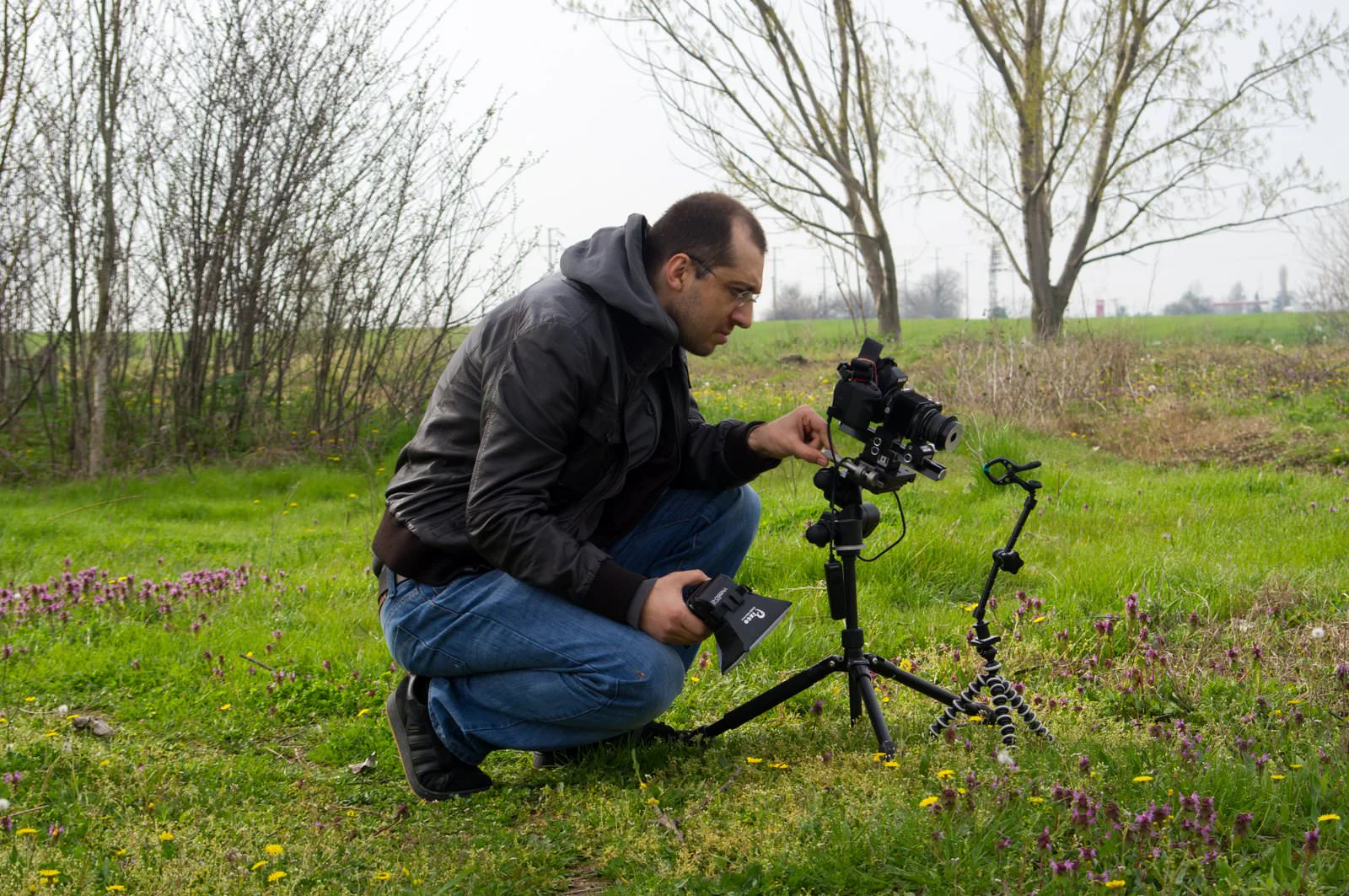
Macro photography using cross-polarized filter technique

Ever since I started taking photos I’d been curious about polarizing filters, yet for some reason I kept them outside my area of interest for a very long time. Even though I knew they have particular importance in macro photography, I probably put it off until now because of their somewhat higher prices.
Polarizing glass has long been used in sunglasses. By blocking reflected light from the surroundings, it relaxes the eyes. On a camera it serves the same purpose—cutting reflections off glass or water surfaces so we can see inside or below. In landscape photography it yields a bluer sky and higher contrast.
Linear polarizer – Circular polarizer
Without diving into technical detail, here’s the practical difference: at heart both filter types do the same thing, and the results don’t differ. But while linear polarizers were perfectly adequate in the old days, they lost popularity with the rise of autofocus bodies, because AF systems don’t work properly with linear polarizers—they need a different design called a circular polarizer. Circular polarizers, abbreviated CPL, cost more than linear ones. If we’re thinking only about macro, we can buy cheap second-hand linear polarizers since we don’t rely on autofocus in macro work. But if you want a general-purpose filter for landscapes and wildlife and figure “might as well get the right thing,” then you should choose a CPL.
Even though I wasn’t actively looking, I came across a used Marumi DHG 72 mm at a good price and decided to grab it. Marumi is known for quality filters. The DHG coating helps reduce internal and external reflections—think of DHG like MC coatings on lenses. There’s a newer “Super DHG” coating as well, but I didn’t chase that.
How to use a polarizing filter


 A tree photographed while rotating the polarizer.
In these two shots, rotating the polarizer reduces reflections on the leaves and deepens the sky. Because this effect cannot be recreated later on a computer, polarizers deserve special attention.
A tree photographed while rotating the polarizer.
In these two shots, rotating the polarizer reduces reflections on the leaves and deepens the sky. Because this effect cannot be recreated later on a computer, polarizers deserve special attention.
Polarizers in macro
Now to the point. What does a polarizer do in macro?
If I say “I don’t know yet either,” I hope that doesn’t sound too silly :)
What I mean is I haven’t decided how essential it is. After some use I’ll likely form a clearer opinion, but it’s easy enough to show and comment on the difference already—so let’s keep going.
By the end of this post we’ll have at least some idea :)
The benefit of polarizers is cutting unwanted glare and specular highlights to produce a more balanced image. On flowers and insect exoskeletons, reflections can be excessive. Even with a large diffuser on flash, the light may not be soft enough. And with natural light, uneven hotspots can be annoying. Our goal is to suppress them.
Polarizing film
A sheet of polarizing film can do the same job as a filter.

These plastic sheets are sold in panels and, depending on their orientation, they either pass or block polarized light. For example, 3D movie glasses work on this principle: the left and right eyepieces have polarizers oriented 90° apart, and the projector alternates frames polarized to match each eye.
Thus, one frame’s polarization lets it pass only through the right eye’s filter; the next frame passes only through the left. Because the two frames have parallax (captured by two cameras spaced like our eyes), we perceive depth. You can even make DIY 3D glasses by covering an old frame with cheap polarizing film.
Why this detour? One key sentence: depending on their relative angle, polarizers either transmit polarized light or block it.
Cross-polarization technique
This is our main topic.
Put differently: if we first polarize the light, we can then control it as we wish—just like the 3D glasses do—either letting it through the lens or not.

This lets us eliminate the harsh highlights that bother us.

I always shoot RAW. Even without a polarizer, that gives some leeway to recover blown areas. But in this test I’m showing the photos exactly straight out of camera, with no adjustments.
First, prep the flash: I taped a sheet of polarizing film to the diffuser. The film was a bit small, so I covered the edges with dark paper to prevent any unpolarized spill—ensuring all light from the flash is polarized.

 Spider, shot with different polarizer settings.
To summarize:
Spider, shot with different polarizer settings.
To summarize:
- Without any filter, reflections are strong even with a diffuser—blown highlights on the leaf and glare on the legs that kills detail. - With the polarizer mounted, overall light drops a bit. Reflections improve somewhat, but the legs still show glare. - At full cross-polarization, specular highlights are gone—but the rendering looks a touch less natural. You may want to compare the three side by side more closely—click to enlarge:

Another example
This time I placed a dead hornet on a leaf and compared a normal diffused-flash shot with a cross-polarized one. There was natural light coming from the front at a shallow angle to the leaf, so I knew the reflections from that direction wouldn’t be suppressed by the filter—and I deliberately left it that way. Outdoors we can’t polarize daylight; there may be hard light coming from various directions. Only the flash is polarized here. I wanted to mimic real-world conditions.
Note: In fact, if you rotate the polarizer appropriately, you can also tame some reflections from natural light. But since we set the filter angle to the film on the flash, we can’t optimize for both sources at once.
This time I also processed both versions in Photoshop, adjusting exposure and balance. The point was to see whether the polarizer still brings a benefit if we allow for RAW post-processing. If glare can be fixed later, why bother with a polarizer? Hardly anyone uses images straight out of camera anymore.
Let’s see whether the polarizer still wins despite those tweaks.


Conclusion
Polarizers steal a bit of overall light. With flash you’ll need to increase power; with natural light you’ll need longer exposures.
At full cross-polarization, reflections are completely cut. That can sometimes hurt the sense of depth and naturalness. Rendering a naturally shiny subject totally matte isn’t always desirable. So while rotating the polarizer, it’s often better to stop at a semi-crossed angle that reduces highlights to a “not blown” level, or to let some ambient light mix in for a nicer result.
Beyond this test, I’d like to try cross-polarization outdoors in real environments and see the results. In fact, seeing the potential, I immediately ordered a second CPL in 49 mm. If you don’t have a polarizer, I recommend getting one—useful for macro and general photography alike.
Update
When the 49 mm polarizer arrived, I sold the big 72 mm one. The more compact we can be in the field, the more comfortable we are. Our lenses are small, so 49 mm is a better fit for macro.
However, even two years after publishing this, I still don’t have a definitive stance. I’ve heard negative feedback from many friends—complaints about light loss and reduced sharpness with polarizers.
On top of that, since I completely abandoned flash, cross-polarization has lost its meaning for me. I’m more than satisfied with what I get from natural light. One thing remains to be tried: using a polarizer with natural light.
As you know, we use reflectors and diffusers to soften light in natural-light shooting. Sometimes, for the sake of traveling light, I skip them. If it’s cloudy or I’m working in suitable shade, everything is fine—but occasionally a patch of hard light still creates harsh reflections. In that case I feel a CPL could help. If I ever head out without a diffuser and remember to pack the CPL, I’ll be happy to test it and share the results.
After a long break I’m picking up my “completely abandoned” flash again—but for a different field: wide-angle macro! A CPL is a must-try with wide-angle macro.