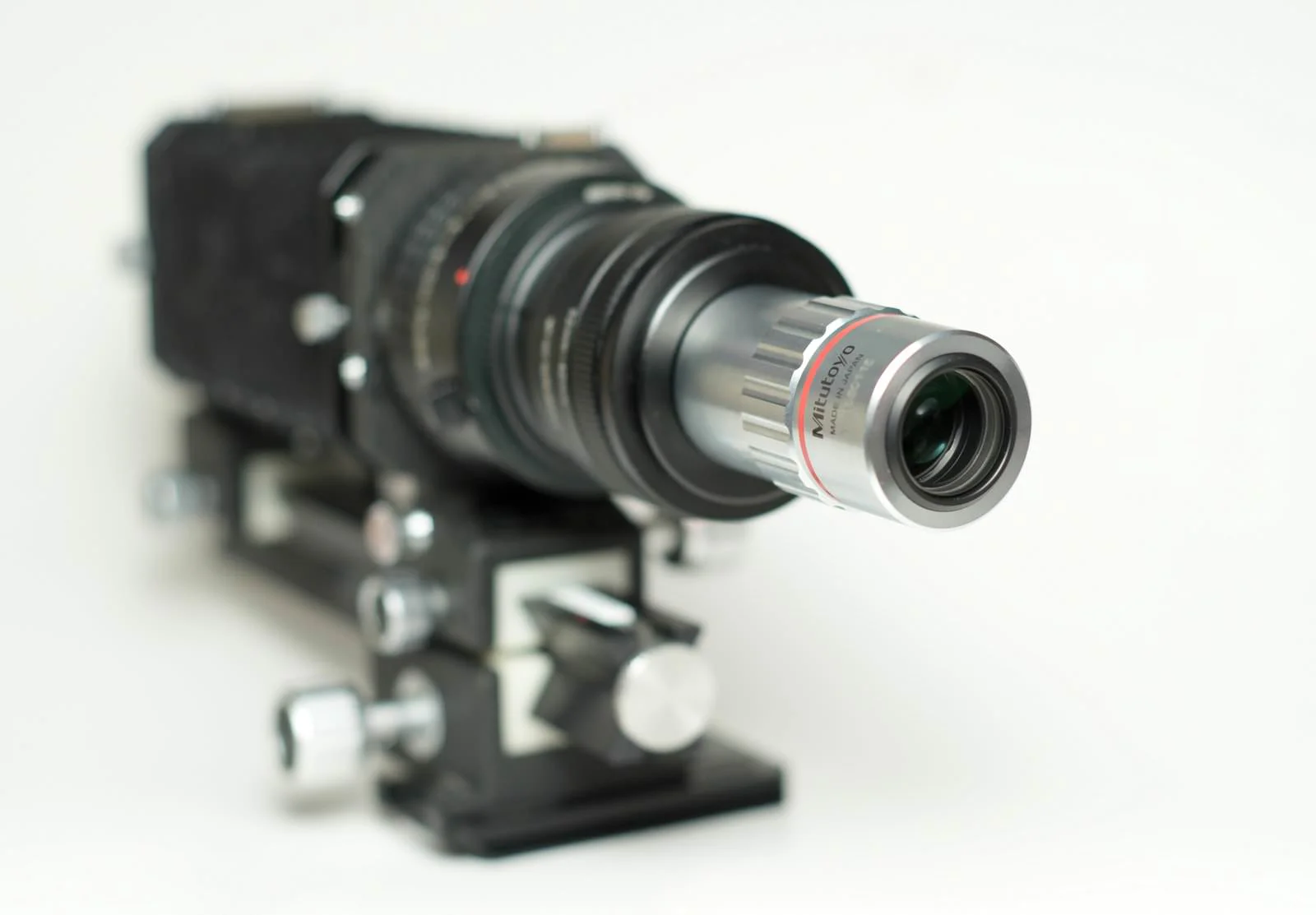
Shooting macro with extension tubes (standard mount)

Under the title Using everyday lenses for close-up work, I’ll revisit—one by one as separate posts—the magnification-increasing methods to examine in more detail and provide examples of the techniques I briefly mentioned.
I’m giving priority to the simple and indispensable macro extension tubes. Since an extension tube is an empty device with no glass inside, it doesn’t harm optical transmission or sharpness. While using all other magnification methods, we have the chance to bring extension tubes into the mix as well—and we’ll be using that chance a lot later on.
In this article, we’ll try different tube lengths with different lenses and measure the magnification. We’ll mount lenses to the extension tube specifically in the normal (non-reversed) orientation, because reverse mounting will be the topic of the next article.
The tubes we’ll use consist of 2 sets: a 68 mm Kenlock and a 60 mm unbranded Chinese tube. In the examples I’ll give, we’ll see the results obtained with 1 set of tubes and with 2 sets separately.

***Note: *I definitely do not recommend cheap Chinese tubes! They can jam in the bayonet or even drop the lens. Use branded, sturdy tubes with your expensive gear.
Automatic Tube – Manual Tube
If the extension tube we use has electrical contacts, it supports automatic aperture. Some of the more expensive tubes even offer autofocus support. Even without electrical contacts, there may be a mechanical lever for auto aperture. If possible, choose ones with automatic aperture support. When you mount modern lenses (with automatic aperture) in the normal orientation on a tube, you can control the aperture from the camera body. The aperture value will also appear in the photo’s EXIF data. With an automatic tube, before shooting, the aperture stays fully open and gives a bright viewfinder image. Focusing is easier. When you press the shutter, the aperture stops down to the set value.
Manual tubes are simply empty metal barrels. The quality of what they do is the same as an automatic tube; being auto or manual doesn’t affect the photo. The only difference is that with a manual tube you must set the aperture on the lens itself. Since there’s no connection to the body, the body can’t read the aperture. You won’t see the aperture in EXIF either—it may show zero or an invalid value.
**Note: **Although it’s outside the scope of this article, we’ll most often prefer reverse lens mounting as the connection type. There are special adapters that even provide electrical connections in reverse mounting, but that’s an exception. Generally speaking, whether our tube is automatic or manual, we can’t provide electrical connection when reverse mounted. We have to set the aperture manually on the lens and get used to a darker viewfinder to the extent that we stop down.
The lenses we’ll use in the test are:
- Pentax SMC M 28mm f/2.8
- Pentax SMC M 50mm f/1.7
- Volna 9 50mm f/2.8 Macro
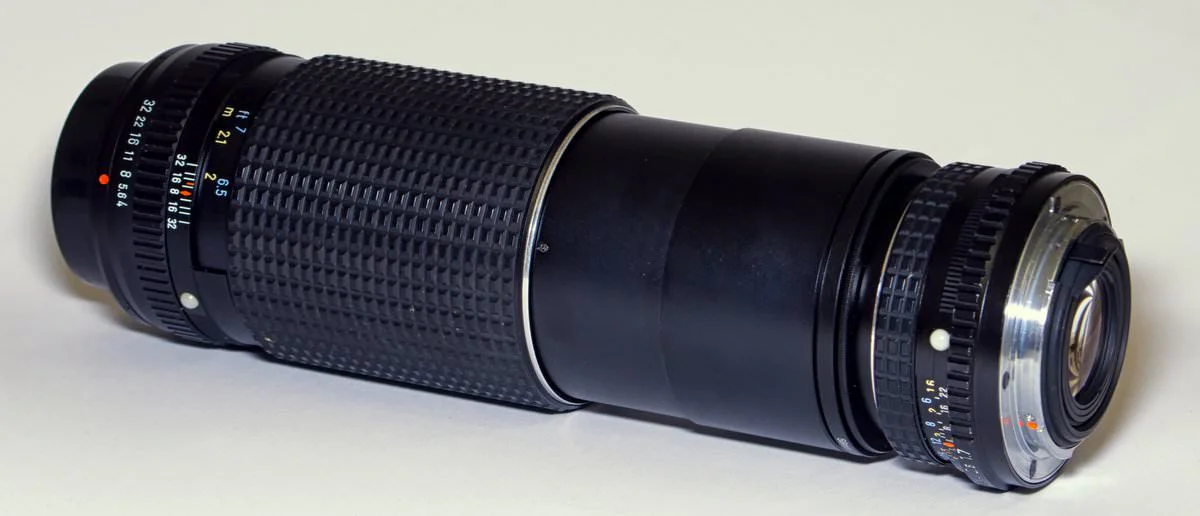
- Tamron 90mm f/2.8 Macro
- Pentax SMC K 135mm f/2.5
I deliberately added two different 50 mm lenses to the list. One is in the standard 50 mm class many of us own, while the Volna 9 is in a different class as a half-macro lens with 0.5× magnification.
To measure magnification, I used millimeter graph paper you can buy at stationery stores. The small squares have 1 mm sides. When processing these photos, I only used Photoshop’s auto-correct for light/contrast, etc.—I paid zero attention to anything aesthetic other than measuring magnification during shooting. So colors and lighting may be off, and since apertures were wide open, let’s ignore sharpness issues, too. My goal here is measurement, not making photos.
When taking the photo, I measured the distance to the paper. I took these measurements not from the lens glass, but from the most protruding part—the closest point to the paper—to give a value closer to practical use. During a shot, the distance that matters for us is that of the part that gets closest to the insect and might scare it—not the glass itself.
Pentax SMC M 28mm f/2.8
It’s a highly capable and sharp lens for normal daily use. It’s also very popular among macro shooters for reverse mounting. Because it’s small and light, I use it a lot for daily shooting as well. I see its fully manual nature as an advantage especially in reverse mounting. With a manual lens, we ourselves set the aperture to whatever we want. Some automatic lenses don’t have a manual aperture ring. When these are reverse mounted, the aperture can be stuck at its minimum. Then we end up (if present) wedging a piece of paper into the lens’s aperture lever to pry it open, and we can’t measure what value we set. Fully manual lenses don’t have such issues.

When we use the lens alone at its 29 cm minimum focus distance, the magnification we get stays at 0.13×. It’s not even adequate for close-up use—far from macro. Distortion is high. With a wide aperture, sharpness drops rapidly away from the center.
When mounting wide-angle lenses normally on tubes, sometimes the tube ends up so long it can push the focus distance inside the lens itself. In such a case you can’t get a sharp image at all. With this lens I could only use a slim, 20 mm tube section. With longer tubes, focus wasn’t achievable. With the 20 mm piece, magnification rose to 0.82×, while working distance dropped to a rather unacceptable ~3 cm. Using our 28 mm lens in macro with a normal (non-reversed) tube mount is a bit of a stubborn choice. But this stubbornness bears very different fruits. By checking out the other article on macro shooting with wide-angle lenses, you can also get an introduction to that world.
Note: In reverse-lens mounting, the Pentax M 28 will shine.

Pentax SMC M 50mm f/1.7
The Pentax 50 mm is a well-known fully manual lens and one that macro shooters love to reverse mount. Let’s test the Pentax SMC M 50mm f/1.7—which scores highly for sharpness and color quality—while mounted normally.

With our 68 mm first tube set, the lens delivered 1.31× magnification—now in macro territory.

With the 50 mm we can reach 2.44×—an “extreme macro” level—using two tubes. However, the 4 cm working distance is a bit short, and we observe optical distortion and edge softness. Using a wide aperture while shooting amplified these unwanted effects.
Note: The Pentax M 50 mm will be quite successful when reverse mounted.
Pentax SMC K 135mm f/2.5
Our K-series 135 mm lens—one of those older manual lenses that Pentax users praise to the skies for its sharpness—is among the lenses more commonly preferred by portrait photographers.
Let’s see what we can do with macro tubes.

We managed to work at 1:1, but by extending a heavy lens too far we put a lot of stress on the mount and ended up with a rather unwieldy setup. Handheld shooting like this will be very uncomfortable. To bring the Pentax 135 to macro level we had to use two tube sets. As you can see, as focal length increases, it becomes harder to boost magnification with tubes.
Another point that caught our attention with this lens is the straight, undistorted lines known as “flat field.” Edge-to-edge sharpness loss is minimal. The K 135 performs well optically.
We need to view the next two lenses differently, because they’re macro lenses. By design, they can focus very close and shoot macro even without tubes. They’re top-tier in sharpness and have “flat-field,” distortion-free focal planes. Let’s see what changes with macro extension tubes.
Volna 9 50mm f/2.8 Macro

The version I have is a fully manual Russian lens from 1987—Volna 9, which has a devoted fan base, very high contrast, and great sharpness. It has a unique star-shaped aperture. At f/2.8 it has a very creamy bokeh character. Although Volna 9 is a macro lens, being from an older generation it works at 0.5× magnification. Such 0.5× lenses are called half-macro.

In my measurement without any tube attached, Volna 9 yielded exactly 0.5× magnification. As is characteristic of macro lenses, sharpness and parallel lines stand out. Working distance measures 9 cm.
When tested with one 68 mm macro tube set and then with two tube sets, we see that magnification increases considerably.
With Volna 9 and tubes we can go up to 3×. We have no issues regarding image quality, but the working distance dropping to 1 cm causes lighting problems. We might use our 0.5× lens with macro tubes up to a certain point, but with long tubes practical use won’t really be possible.

In this test, Volna 9 won my heart yet again. Sparkling images, vivid colors, and butter-smooth bokeh make this lens indispensable for me.
Volna 9 is very successful for lower-magnification macro like flowers and butterflies, and for portraits. It deserves another review of its own.
Tamron 90mm f/2.8 1:1 Macro

As we already know, on its own the lens provides 1:1 magnification, and with the millimeter graph paper it produces a photo that shows exactly the size of our camera sensor. From this perspective, 1:1 lenses even let us measure our sensor size :)

If you count the squares in the first (1:1) photo, you’ll see the Pentax K-x sensor size of 23.6 mm × 15.8 mm. No surprise there, of course. My purpose in taking this photo is to provide a reference that lets me measure all the other magnifications. In this photo, one square is 184 pixels. I compare the square size in another photo shot with different equipment and calculate magnification. You can do the same by comparing the number of visible squares across two different photos.
Since the Tamron 90 mm has a telephoto focal length (90 mm), the extra magnification brought by an extension tube won’t be that much—in other words, it requires longer tubes.
Let’s look at the sample photos right away.

Like the Volna 9, the Tamron 90 mm immediately shows it was made for macro. Colors and sharpness—even at the edges—are at the desired level. Thanks to its 90 mm focal length, the working distance advantage allows you to approach at higher magnifications without spooking the insect.
In conclusion, if we’re going to use lenses in the normal orientation with macro extension tubes, the lenses we choose should be true macro lenses. We can’t bring lenses made for everyday use to great places with a normal tube mount. Even if we can increase magnification, sharpness isn’t that great.
Different uses for macro extension tubes
Tubes are like magic wands. They can adapt to everything and slip in between any connection. If you’re going to get heavily into macro, I recommend getting a few tube sets with different characteristics.
Same-mount tubes as the camera body
We can use these for both reverse and normal mounting—every which way. Also, I especially don’t mount a bellows directly to the camera body. If the bellows is too close to the body, it can bump when rotating. By placing a slim tube between the body and the bellows, I make mounting and unmounting easier. Sometimes I do the same in front of the bellows: instead of mounting the lens directly to the bellows, adding a slim tube between the bellows and the lens helps.
With telephoto lenses, I use a slim tube to focus closer than the lens allows. When a bird lands closer than your lens’s minimum focus distance, not being able to photograph it is frustrating. A tube lets us overcome that.
M42 tubes
M42 is an old bayonet standard—also known as “screw-mount.” Whether lens, bellows, or tube, gear in the M42 standard can usually be purchased much more affordably than modern counterparts. M42 systems can be adapted to any bayonet with adapters. That’s why M42 became a transitional standard for me. For example, instead of looking for an RMS-to-Pentax adapter for a microscope objective, I get an RMS-to-M42 adapter. And since I currently use Sony, I don’t have to search again for an RMS-to-Sony adapter. Because I already have an M42-to-Sony adapter, I use the whole setup the same way on Sony.
M42 adapters are very common and very cheap for all systems. Therefore M42 tubes are also very handy as pass-through elements for any system. Highly recommended.
Note: Since M42 is a full-frame-compatible standard, it won’t cause corner vignetting on full-frame bodies.
M39 tubes
M39 is the system used by Leica and the little sibling of M42. Its importance for us comes from enlarger lenses. Almost all of these lenses use the M39 mount. In macro we reverse-mount enlarger lenses, so we don’t use the M39 end—but the M39 tube is still very important to us.
You can mount the lens normally and use it for general purposes. Since enlarger lenses don’t have a focus ring, we need to bring focus to a certain distance by attaching a tube or bellows.
When we reverse mount the lens, they serve another purpose. By attaching a short tube to the outward-facing M39 side, we effectively make a “hood.” One of the simplest ways to increase the contrast of our photo is to use such a shade.