Accessories for natural light, tripods, and holders

Spring is here; macro season is open. The nice weather, flowers, and bugs we dreamed of all winter are waiting for us outside. But this time, instead of grabbing the gear and diving in headfirst, I want to chase the goal I set for myself: “use of natural light.”
Before using natural light, it’s important to address equipment gaps
That’s why I spent the winter running various tests and trying to fix what was missing. Beyond building muscle memory and becoming more patient, there’s also the equipment side of things. In this post, I’ll give examples of tools that make our job easier and help us get more successful results. Choosing them is entirely about personal preferences and constraints. As time goes by, different methods and devices come into my hands; one thing replaces another. Different products that do the same job can easily be used. Whatever you can get your hands on, try to use that.
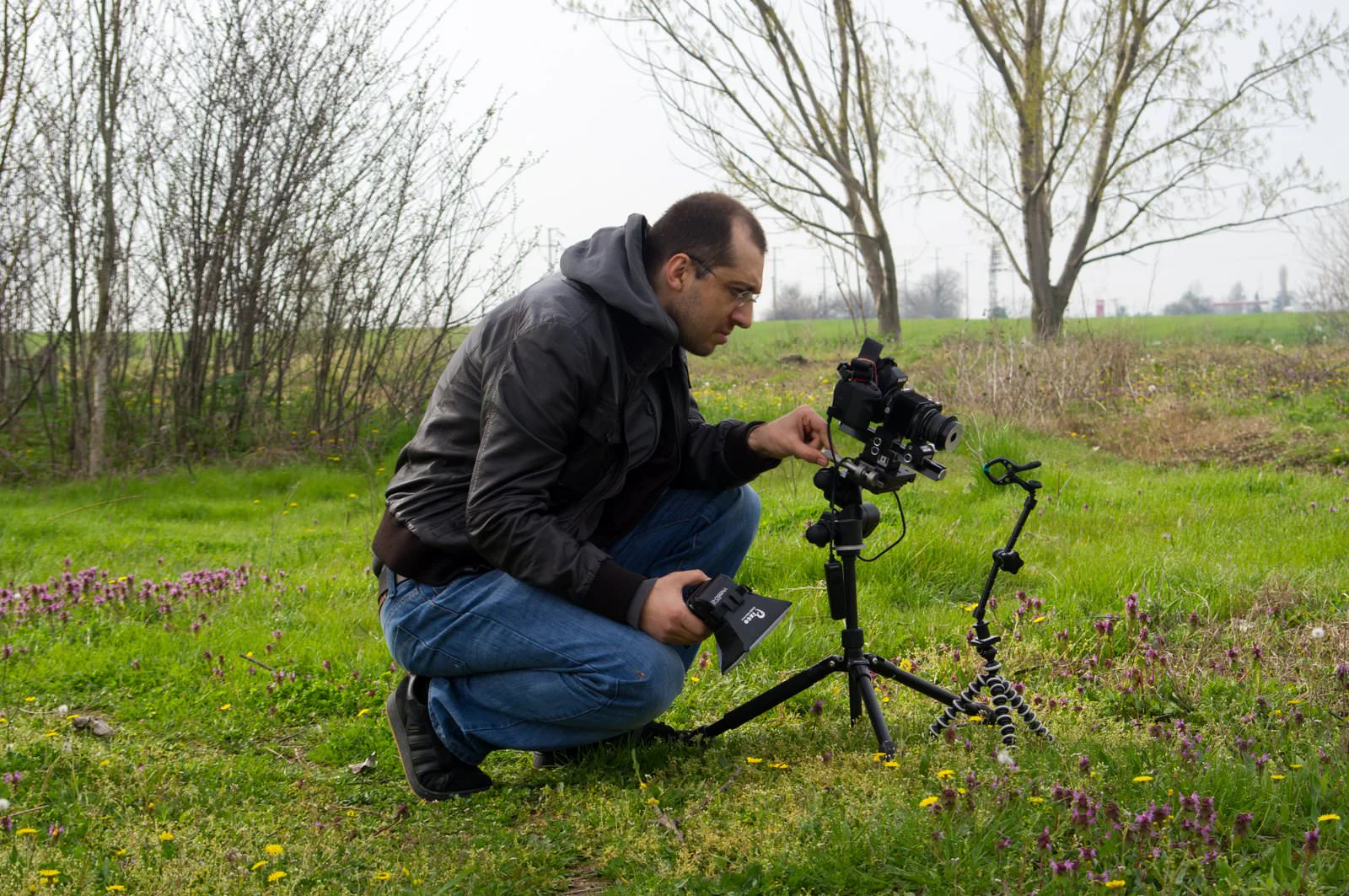
If we’ve decided to use natural light, going out for outdoor macro shooting means carrying a mini studio with us. To be able to direct the light, we should use a diffuser and reflector, and we should block the wind and other vibrations. At the same time, all these tools should be easy to carry and the setup/teardown shouldn’t be a pain. Although there are still points I’m undecided about and some gaps for certain needs, the helpers I plan to use in the coming period are generally as follows:
Tripod
Of course, the most essential, indispensable item among them is a tripod. In natural light shooting, we’ll be doing long exposures. Although the exposure time varies with the light, it’s almost never short enough for handheld shooting. It’s usually between 1/10 s and 2 s. I prefer to use slightly dimmer light and keep the time longer. That way I’m less affected by shutter shock. When we expose long, after the initial shake at the start of the exposure dies out, we end up with a body that doesn’t vibrate during the remaining exposure time.
Note: Shutter shock is not an issue with EFSC-supported Canon bodies and with mirrorless models like Sony NEX and Olympus.
Benro A0691T Travel Angel Tripod
This is the model I have. When choosing a tripod, I aimed for something suited to a general purpose. I actually chose this model even though it’s a bit troublesome for macro. Overall, the Benro gets the job done for me. It’s sized to carry everywhere. Sturdy and light. It weighs 1.33 kg and supports up to 6 kg.

The Benro comes with a B00 model ball head attached.
In this form it’s perfectly sufficient for large insects like butterflies or for flower shots. But when moving to higher magnifications, we generally face a serious framing problem. For example, say we want to do a portrait study of a fly. After setting the frame and tightening the ball head to lock the camera, when we take our hand off, a natural tilt occurs the moment the camera’s weight loads onto the tripod head. Even if this tilt is a tiny fraction of a millimeter, when we look through the viewfinder we realize we’re no longer seeing the fly’s head but its legs.
Loosen again, this time hold the frame a bit higher, tighten, release. Unfortunately, now we’re seeing the fly’s abdomen. Loosen again… This loop takes minutes. If you’re working with a live insect, most likely it will fly off before you finish your adjustments. Or if it twitches, the frame will be ruined and you’ll go back to square one to adjust the tripod head. That’s why it’s useful to go for a revision on the tripod head.
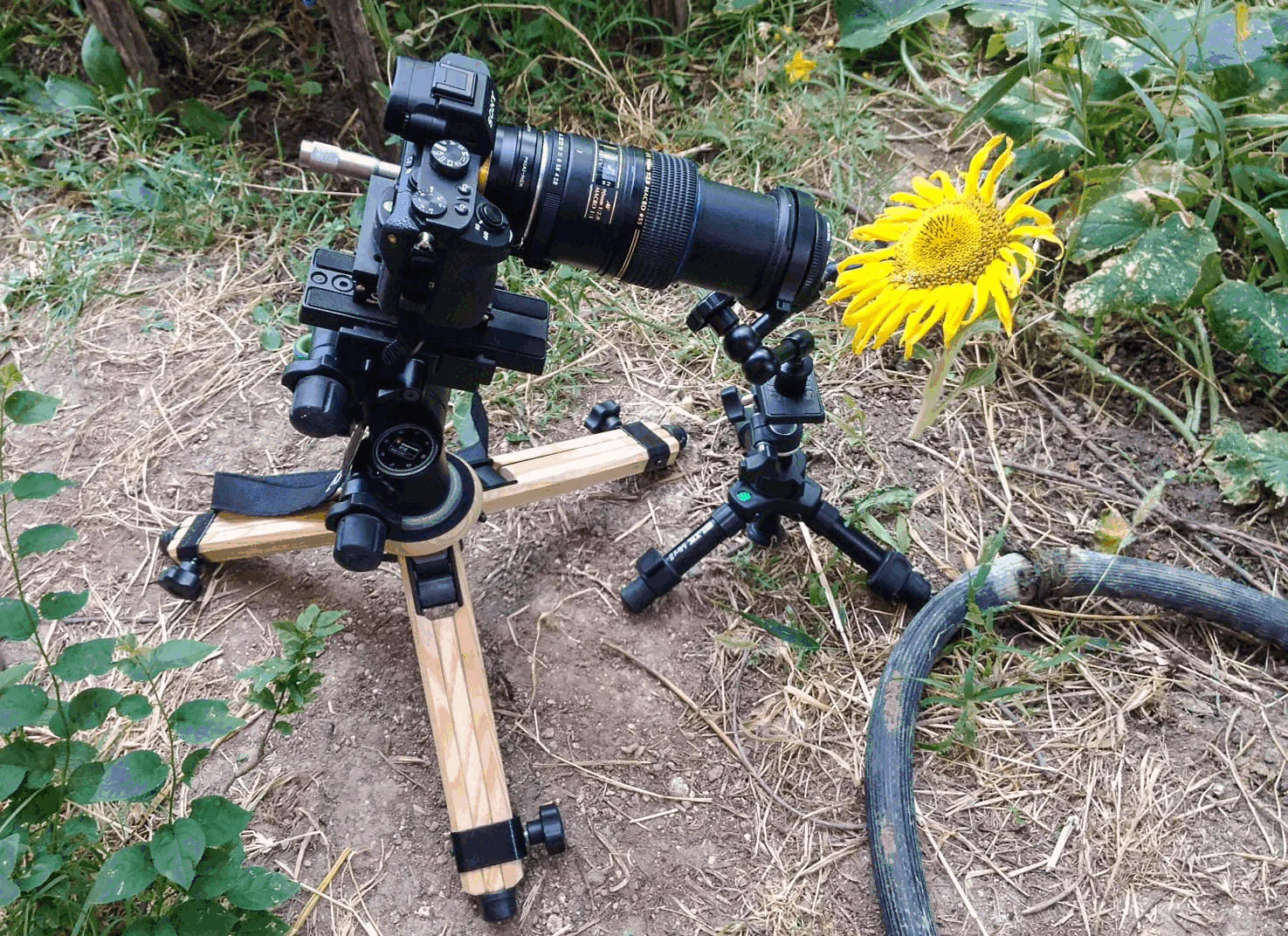
Another problem with the Travel Angel is that it’s not possible to get close to the ground. As you can see in the photo above, when we splay the legs, we have to raise the center column. The camera still ends up high. When the camera is high, it’s essentially on a thin metal tube, so the vibrations take a very long time to die out. For this reason, I plan to cut down the center column from the bottom, since I never raise it anyway. After a while, I’d also like to switch to wooden tripod models that can go down to ground level and are very successful in terms of damping vibrations.
Manfrotto junior geared head 410
Despite its slightly bulky and clumsy look, the Manfrotto 410 solves the framing problem at the root. We remove the old head and easily mount this in its place. That’s it.
This head has a mechanism that provides precise movement on 3 axes. By turning the three wheels belonging to three different gears as we wish, we can move up–down, left–right, and tilt to either side. While making these movements, the camera is securely attached and our eye is at the viewfinder. Since there’s nothing we tighten or loosen afterward, the frame doesn’t get ruined. With the Manfrotto 410, I can precisely set the frame I want even at 10X magnifications with microscope lenses.


Right behind the fine adjustment screws there’s a second butterfly-shaped screw that’s springy, so it’s a bit stiff to turn. When we want to make a large shift, we turn this to disable the fine screw. The head is free on that axis. We roughly bring it in one move to the position we want, let go of the screw and it locks again. Then we continue with fine adjustment.
This head also provides great convenience with long tele lenses. I love using it with a 500 mm mirror lens and teleconverters.
The Junior Head 410 doesn’t move very far up and down. Not very important in macro. We can’t tilt the system too far down anyway to avoid sagging on our Newport rail. But when using telephoto, I’d have liked to raise it even more. Birds in trees generally require looking upward.
Macro rail

I previously wrote an extensive article on the Newport. Rather than repeating the details, I’m sharing its link:
General-purpose mini tripods
I treat these as a different class. When these types of tripods are marketed, they’re shown with DSLRs mounted with large tele lenses, but in reality their carrying capacity is very low. Because they’re made of plastic, they’re very light, and since they’re small, there are no portability issues. In fact, they can get along quite well with small compact cameras too. In short, it’s good to keep a few in the drawer.
Gorilla tripod
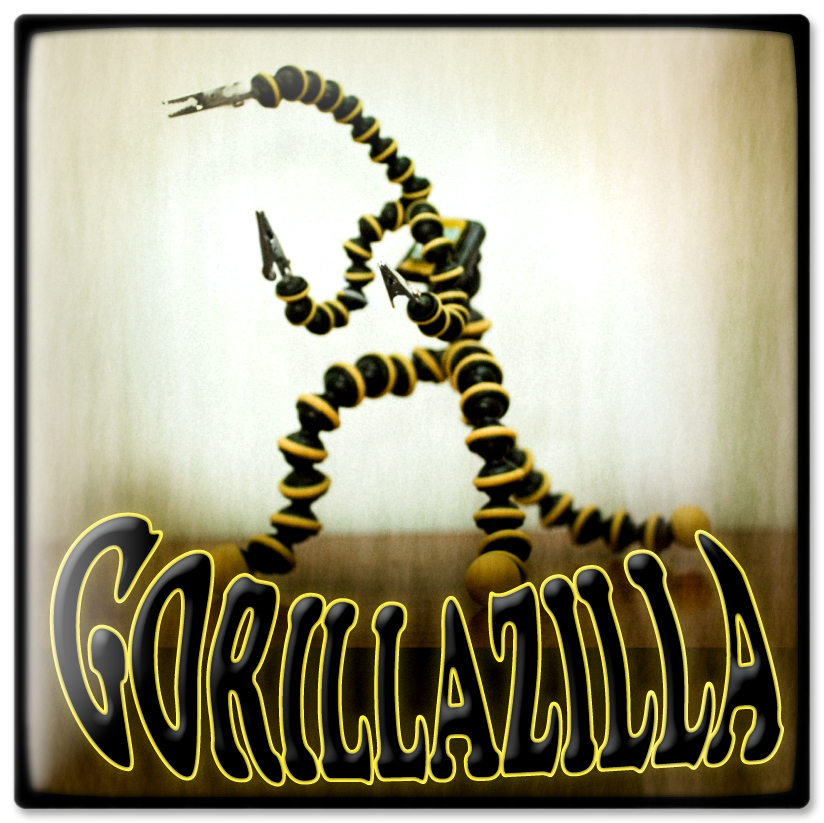
The Gorilla tripod family has several models in different sizes and with different carrying capacities. I bought one medium and one large size. My real intention was to bind them together and make the monster John Hallmen dubbed “gorillazilla”! With its three clamps it seemed capable of holding both a diffuser and a specimen.
My cousin Kerem built the Gorillazilla before I did. He used it for a while too. The monster’s lower legs were wrapped around one leg of the main tripod so they all worked together. But after a while he didn’t find it practical enough and gave up on the Gorillazilla. So I didn’t try it either. We decided to evaluate them separately.

Slik mini II tripod
The Gorilla tripods’ jointed legs and lightness sometimes become a problem. They don’t always allow vibration-free holding. That’s why we needed something a bit better, especially to hold the area where the insect is located. After a bit of research, it turned out the Slik mini II tripods work well. Again, my cousin beat me to it. After seeing and inspecting his, I decided to get one too.

When we lower the Slik tripod’s center column, it can also stick to glass-like surfaces with the suction cup on it. But we shouldn’t interpret that as being able to stick it to glass and use it suspended in the air. At best, it can be used on flat surfaces like a glass table to provide better grip. If you ask me, it’s not a very meaningful feature. Aside from that, the technical details say it has a load capacity of 1.24 kg. That’s quite a good value.
Specimen holders and stabilizers
After stabilizing the camera, it’s time to stabilize the subject. Since it’s extremely difficult to move the entire setup to a different position for each shot, we generally prefer to move the insect rather than the camera. For example, when we come across a bee sleeping on a leaf, we cut that leaf with scissors, take it along with the insect, and place it in front of the camera. It’s very important that the shooting object or insect does not sway in the wind. Oscillations so small that we can’t perceive with the eye lead to a completely blurry photo. The higher the magnification, the more we amplify the effect of these oscillations.
Of course, the holders’ only job isn’t to stop the wind. The diffusers or reflectors we’ll use to shape the light as we wish need to be in the right position. That’s where the holders come into play.
Helping hand
These small clamps go by different names. When searching for them online, we can easily find them by writing “helping hand.” Although I mostly use helping hands for high magnification in indoor studio shoots, they can easily be used in the field as well. By positioning them on height-adjustable stands, we can raise them to the level of our camera and assign them as multi-purpose holders.

A helping hand has two clamps. By loosening their screws we can bring them into any position we want. While a single one is sufficient in studio shooting, when working outdoors it’s better to stabilize the object using both clamps. Objects with broad surfaces like leaves become very sensitive to wind when clamped from just one side. Just like a sail… Or if we clamp herbaceous plants this way on one side, they start to wilt quickly. In each frame of the stack process, a slightly more drooped image appears. These are prevented by double-sided stabilization.
A magnifying glass also comes with helping hands. Since they’re intended for delicate repair work, a magnifier is included in the package. We take it out to use in other fun activities,
Friction arm
The full name appears as “Adjustable Friction Articulating Magic Arm”! In short, we can call it an adjustable articulated arm. These are connector arms used as intermediate elements. When we loosen the locking screw, the arm folds and the balls holding the mounting threads at both ends also loosen. In this state you can rotate and shape it in every direction. After bringing it to the position we want, we tighten the screw again and the system stays fixed in that pose. It can be useful in all sorts of ways that come to mind. It can be a flash holder, diffuser, reflector holder. With alternatives sold in different lengths, I can say they’re very handy elements.

In the photo above, two models of 7” and 11” are seen with different add-ons on them. I attached a mini ball head to the shorter 7” one on the right to increase both its length and maneuverability. The clamps on both can be found at places like Koçtaş or Bauhaus. To attach the clamp, it was enough to slightly widen the small hole already on the clamp arm with a screwdriver to match the screw on the arm.
All in one
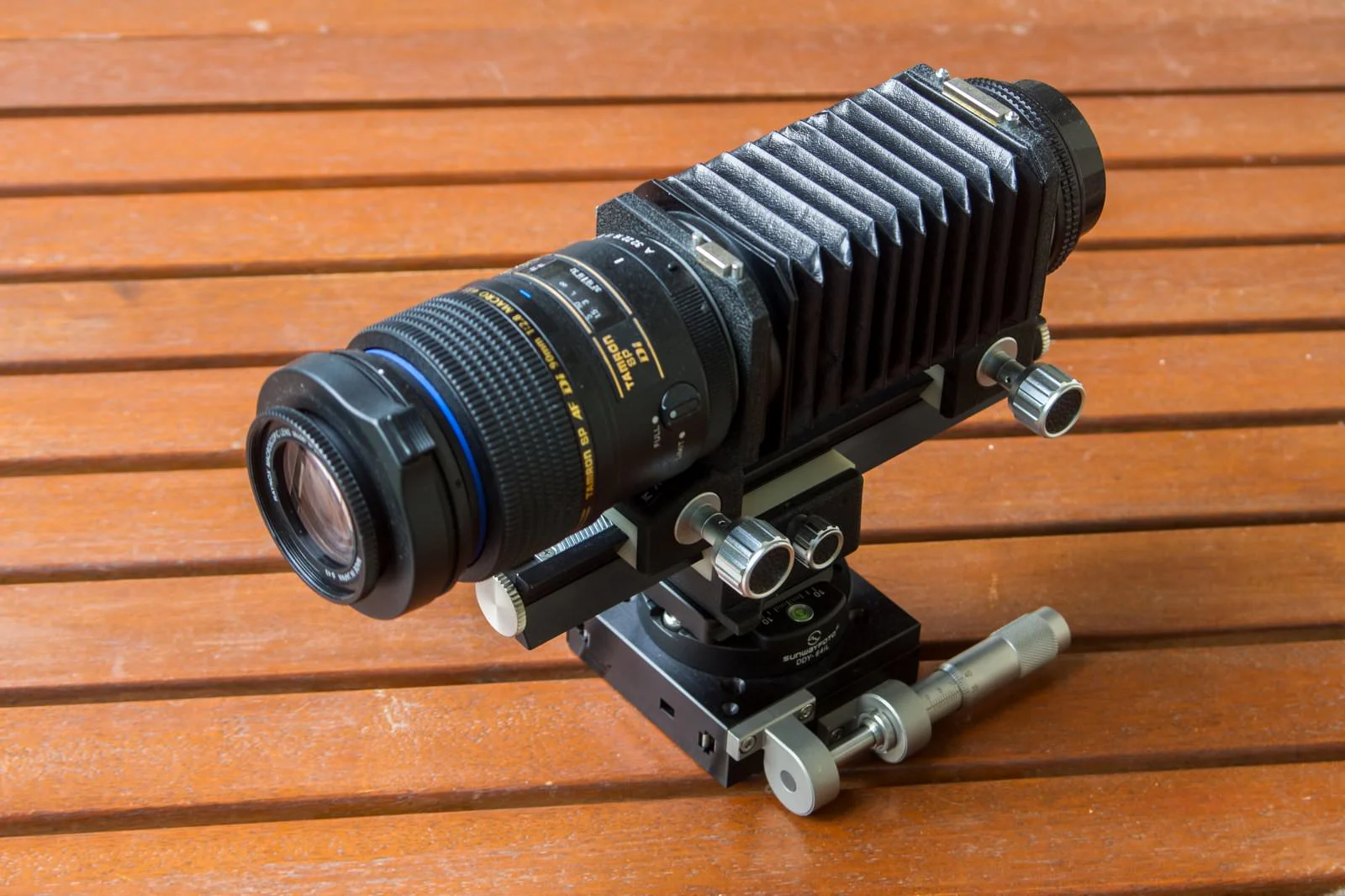
Now we can start forming Voltron. Let’s attach the clamped arms onto the tripods. Let’s mount the Manfrotto 410 head on the Benro. Let’s also place the bellows, lens, and rail on the head:


We’re almost ready to shoot. How we use the holders is up to us a bit. I use one of them to hold the paper/plastic sheets that I’ll use as a diffuser or reflector depending on the light situation. The other acts as a specimen holder. There are two ways to use the specimen holder. Our first option is to cut and bring the object along with whatever it’s on, like a branch or leaf. Then we’ll directly hold the object.

In the example above, a bird feather is chosen as the subject and fixed with the holder. The other holder uses a piece of cardboard serving as a reflector. Of course, in a real shoot, these would need to be in more suitable positions. One side of this paper is white; the other side has an aluminum coating. These papers are the cartons used by restaurants that deliver to cover the food. When I want to reflect sharper light, I use the shiny side. But usually, reflecting with the white surface is better. I use these a lot during shoots.
If we add our lens as well, we get a view like this.
Another way to use the specimen holder is to directly stabilize the branch the insect is on. If the location is suitable, this can also be preferred. Thus, by preventing the branch from moving in the wind, we can do long exposures with natural light.

I didn’t dwell much on diffuser use in this post. I haven’t quite settled it in my head yet. It could be tent use or white plastic. After trying different methods, I’ll share my thoughts.
Tripod doll
It’s not directly related to the topic, but I can’t help sharing. Now let’s see what happens if we leave these materials lying around!


After the shoot that day, while the materials were set up in the garden, I spent about half an hour inside. The fun continued in the garden while I was gone. Especially if you have a 5-year-old daughter, you should be more careful. At any moment, anything can be dressed up, adorned, and turned into a playhouse prop. As seen in the figure: A tripod doll!