Natural light and focus stacking in cold weather
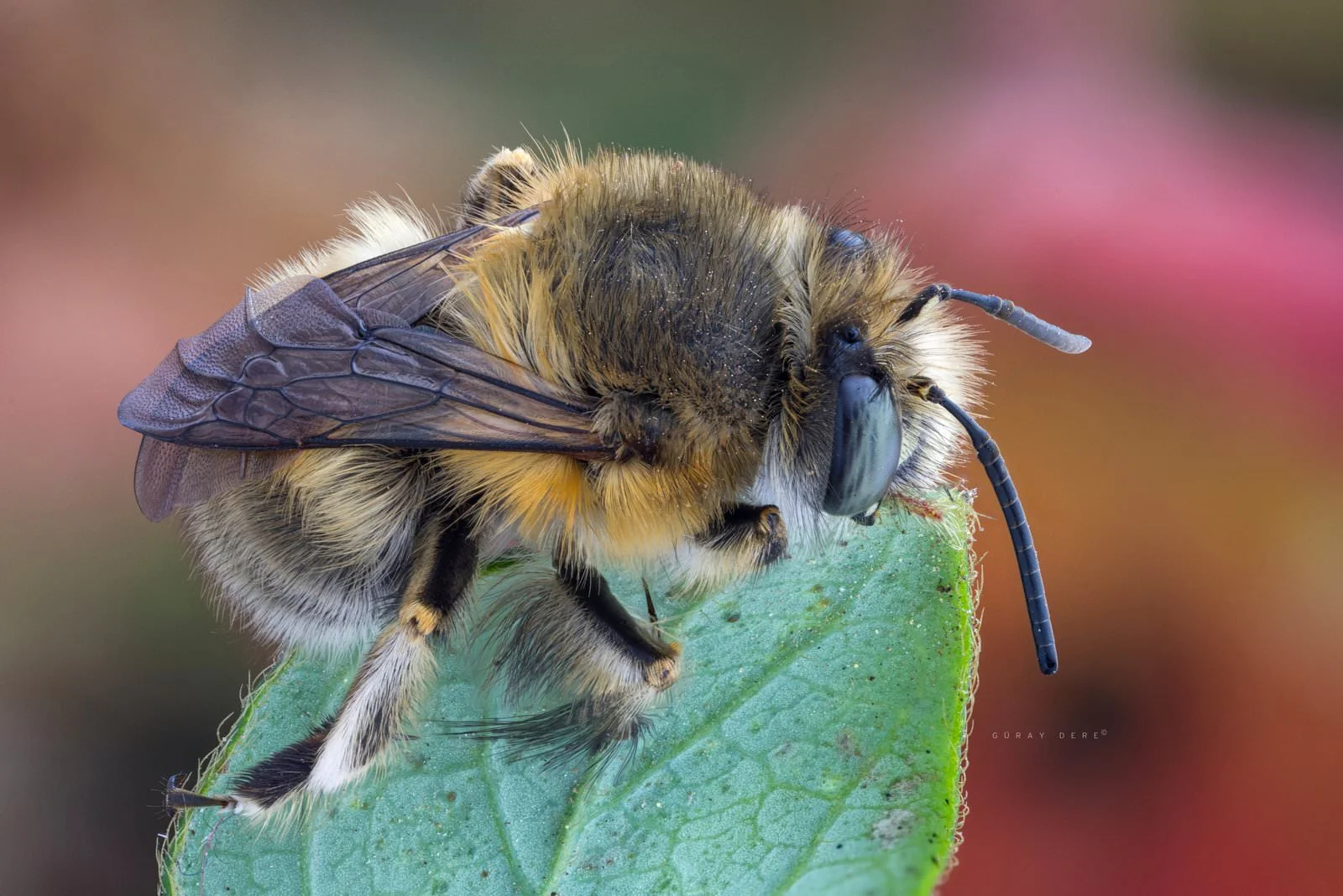
We’re in the dead of winter. Winter brings to mind wind, snow, and storms, but this year Istanbul is having a mild and dry winter. While that’s bad news environmentally, it creates ideal conditions for natural-light macro shooting that rival summer.
The biggest challenge of doing focus stacking outdoors is catching insects while they’re motionless. A single sequence of 30–100 photos takes minutes. Waiting for gusts of wind to die down and dialing in settings for the light shifts caused by the rising sun and moving clouds lengthens the process even more. The longer it takes, the higher the chance the job will end unfinished. Because insects aren’t completely still. They move their antennae and legs. After a while they take a big step and ruin the composition entirely—or they just fly away.
The way to keep insects still is cool air. That’s the “ideal condition” I mentioned above.
In summer, to do natural-light focus stacking you need to get up very early.
Last summer my cousin Kerem and I often went out to shoot at sunrise. In summer this is the most sensible way to do it. Finding insects in summer isn’t a problem, but there’s very little time after the sun rises. The air warms quickly and the insects get moving. As the sun shows itself, colors change so fast that the colors at the start and end of a stack can be completely different. At sunrise in summer, the time we have is at most two hours. After that everything gets lively and we head home with the headache that comes from waking up early.


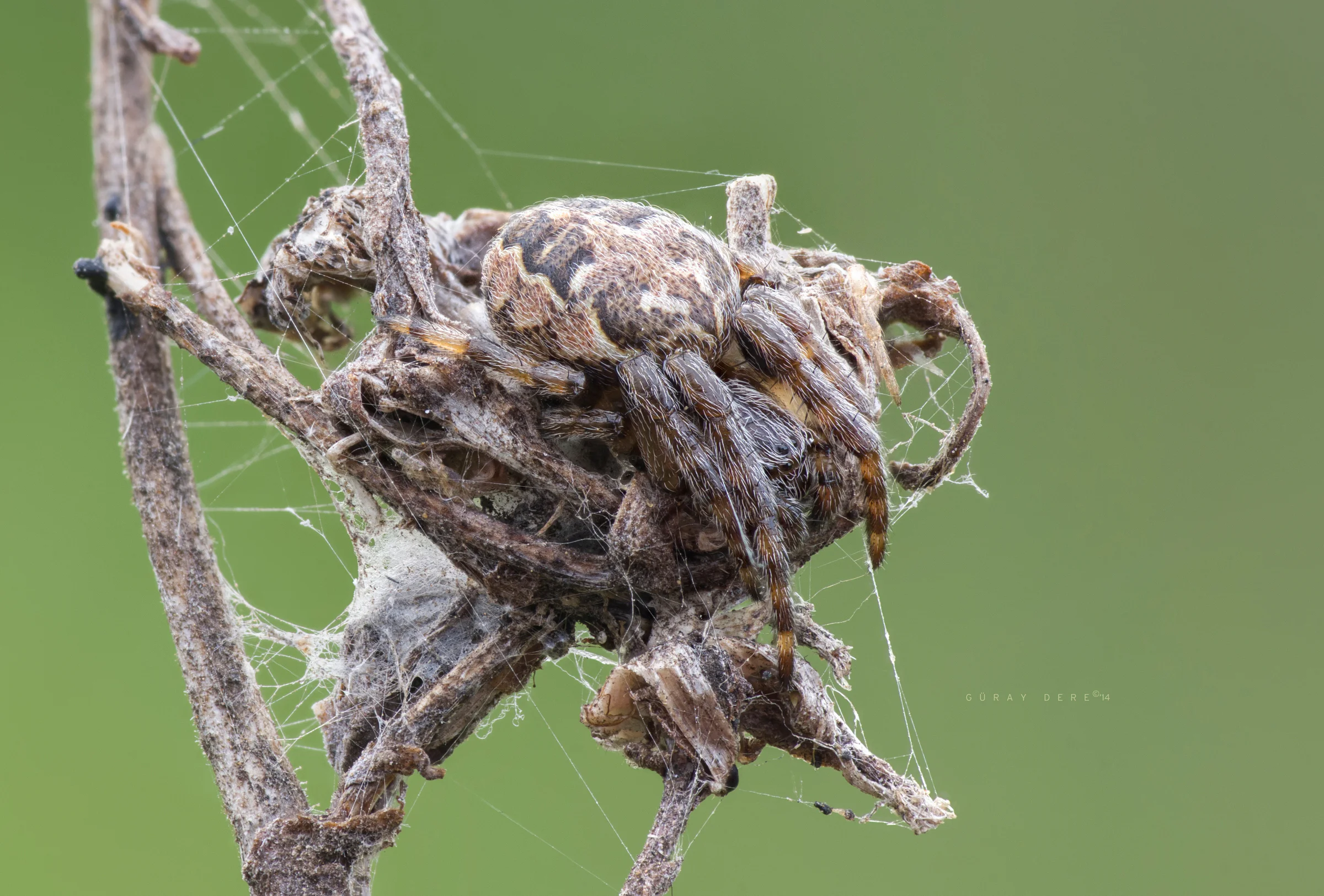
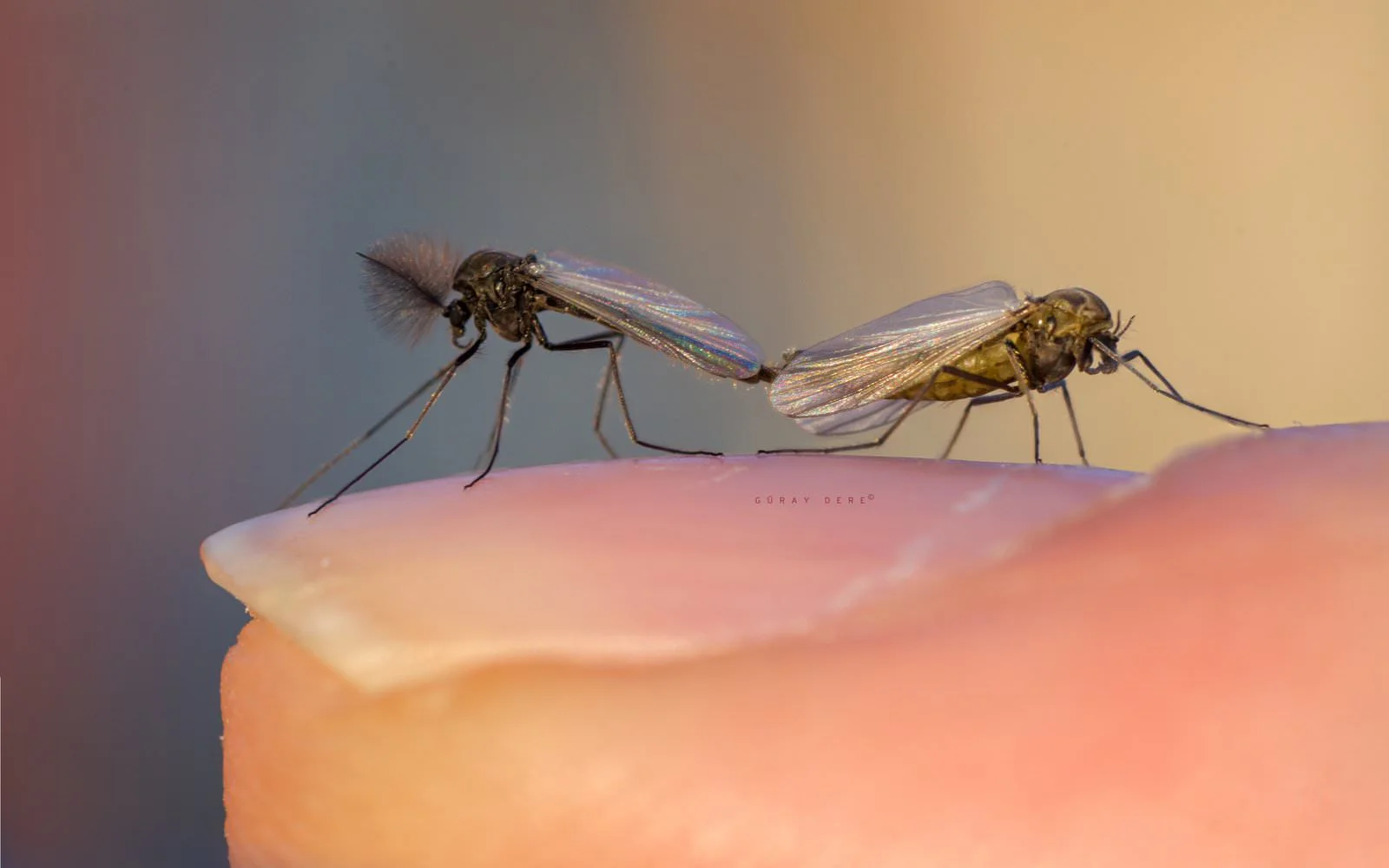
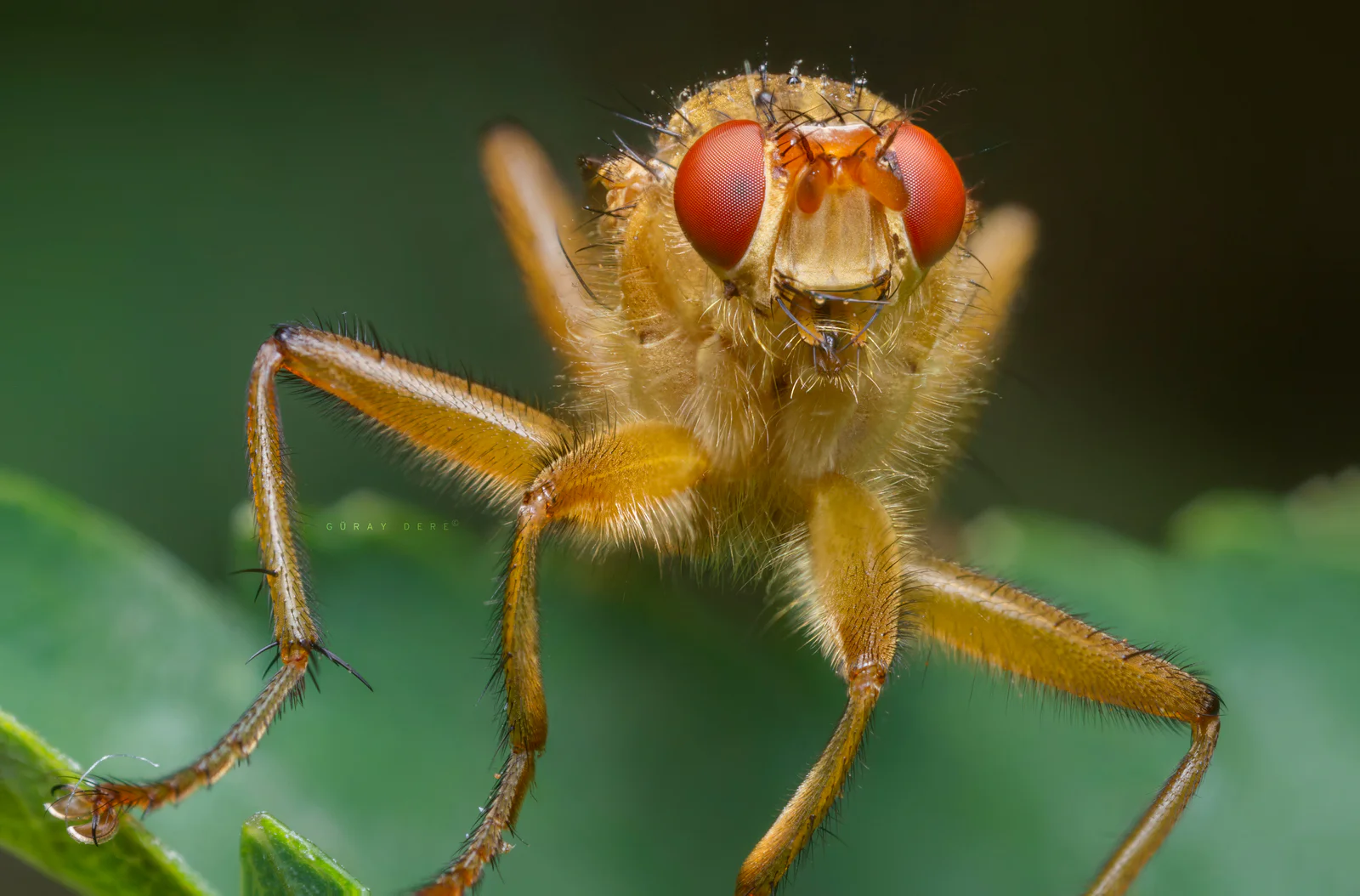
For photos that many people love—those with lots of dew drops—early morning hours are perfect. The two examples above were shot with flash at summer sunrise. While dew droplets are pleasing, I don’t like it when every single shot from the same day looks like that.
Now to winter—or rather, to the winter day of February 1 that I’ll focus on in this article.
On that day I stepped into the garden just to get some air; taking photos wasn’t on my mind at all. With a cold and cloudy 5°C breeze, what comes to mind is sipping something hot rather than photography. But out of habit, I suppose, my eyes kept scanning the leaves. And then…
But first, a quote,
There’s a great book on genetics and biology called “Your Inner Fish.” In it the author at one point talks about his youth. Back when he was still an assistant, he would sometimes go out into the field with his professors to collect fossils. Everyone grabbed a sack and spread out over the hills and rocks of the study area. When it was time to regroup, the professors’ sacks were always full while the assistants’ were empty. This bothered him for a long time. As years passed, he realized that eyes that keep searching for the same thing eventually start to immediately spot a tiny tooth fossil among a pile of pebbles. And with time, he too began returning with a full sack. I think the same thing applies to us—we often talk among ourselves about how we’re developing the “insect spotting” ability.
So, as I was saying, when I turned back to go inside, a fuzzy figure under a leaf on the honeysuckle caught my eye from afar. A bee from the genus Habropoda was fast asleep in the cold, clinging to the leaf with its mandibles. Many insects secure themselves in a suitable position like this at night and go to sleep. Guessing that ours wouldn’t wake easily in this weather, I decided to try my luck.
A week earlier, while chatting with my cousin, we had talked about using a softbox tent in the field. Kerem said he’d been using it for all his recent shoots and was very satisfied. It was a perfect opportunity to try the tent outdoors. I dashed to grab the cube-shaped tent that had been sitting in the closet for ages and set it up on a chair in the garden.

Sample gear for natural-light macro
My natural-light kit keeps changing; as you shoot, you’ll find solutions that work for you.
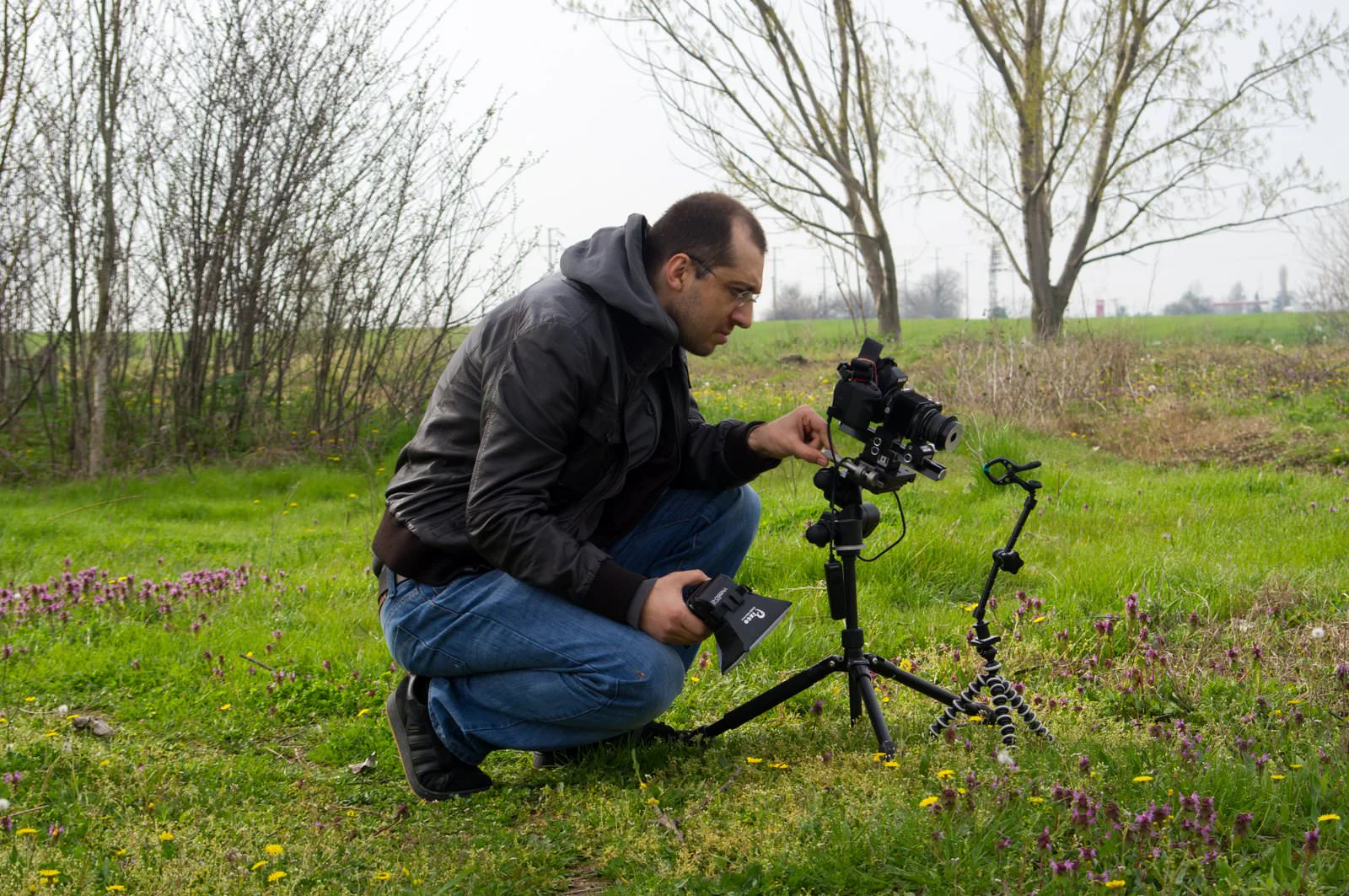
- Softbox tent: These white cube tents are sold in various sizes. Thanks to their springy construction they fold and unfold easily. They provide the soft light we’d normally achieve using diffusers and reflectors, all by themselves. Another nice perk is blocking the wind to create a stable shooting environment. Still, keep diffusers and reflectors on hand.
- Helping hand: I use these clamps as specimen holders. I sometimes keep an extra one just to hold materials that serve as diffusers or reflectors.
- Scissors: Preferably pruning shears. To take sleeping insects along with the twig they’re on and bring them to our field studio.
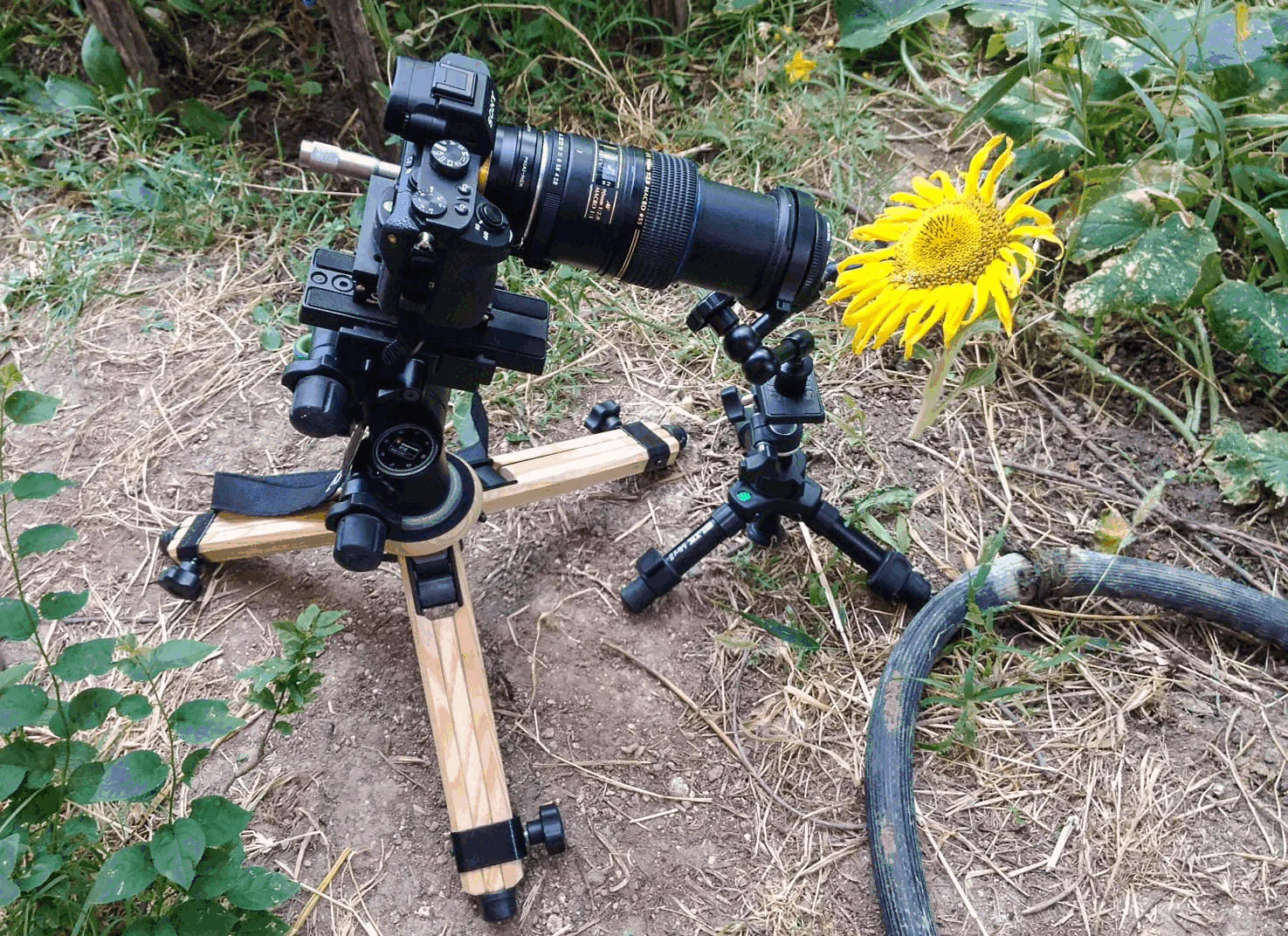
- Tripod: It should be sturdy, stable, and able to get low to the ground. Cheap tripods can cause trouble. My Benro A0691 m0del tripod performs only moderately well. Instead, I’d like a tripod that goes all the way down to ground level and, rather than metal, is made of wood that damps vibrations quickly.
- Tripod head: As magnification increases, composing the frame gets tricky. Ball heads are a pain with constant loosen–tighten. You think you’ve tightened it and locked the camera, but as soon as you let go it droops a tiny bit and ruins the composition, and you’re back to loosen–tighten. The Manfrotto 410 Junior head, with geared movement on three axes, lets you fine-tune composition even while shooting.
- Fine focus rail: To do focus stacking with precision, micrometer rails like the Newport 423 or 433 are excellent.
- Coarse focus rail: Our fine rail only travels a very limited distance. We use the coarse rail to set focus when changing magnification and to choose the first focus point; the rest is done with the fine rail. Since I’m using a dual-rail bellows here, the lower bellows rail serves as the coarse rail.
- Remote shutter release: Pressing the shutter by hand will shake the whole setup, so use a wired or wireless remote. Unfortunately my remote’s battery died that day, so I had to press by hand. I tried to compensate for vibration by using a 2-second delay.
- Spare batteries and memory card: Always have them. You never know what you’ll run into. Focus stacking requires a lot of frames. Coming across a rare species when your resources are depleted can be heartbreaking.
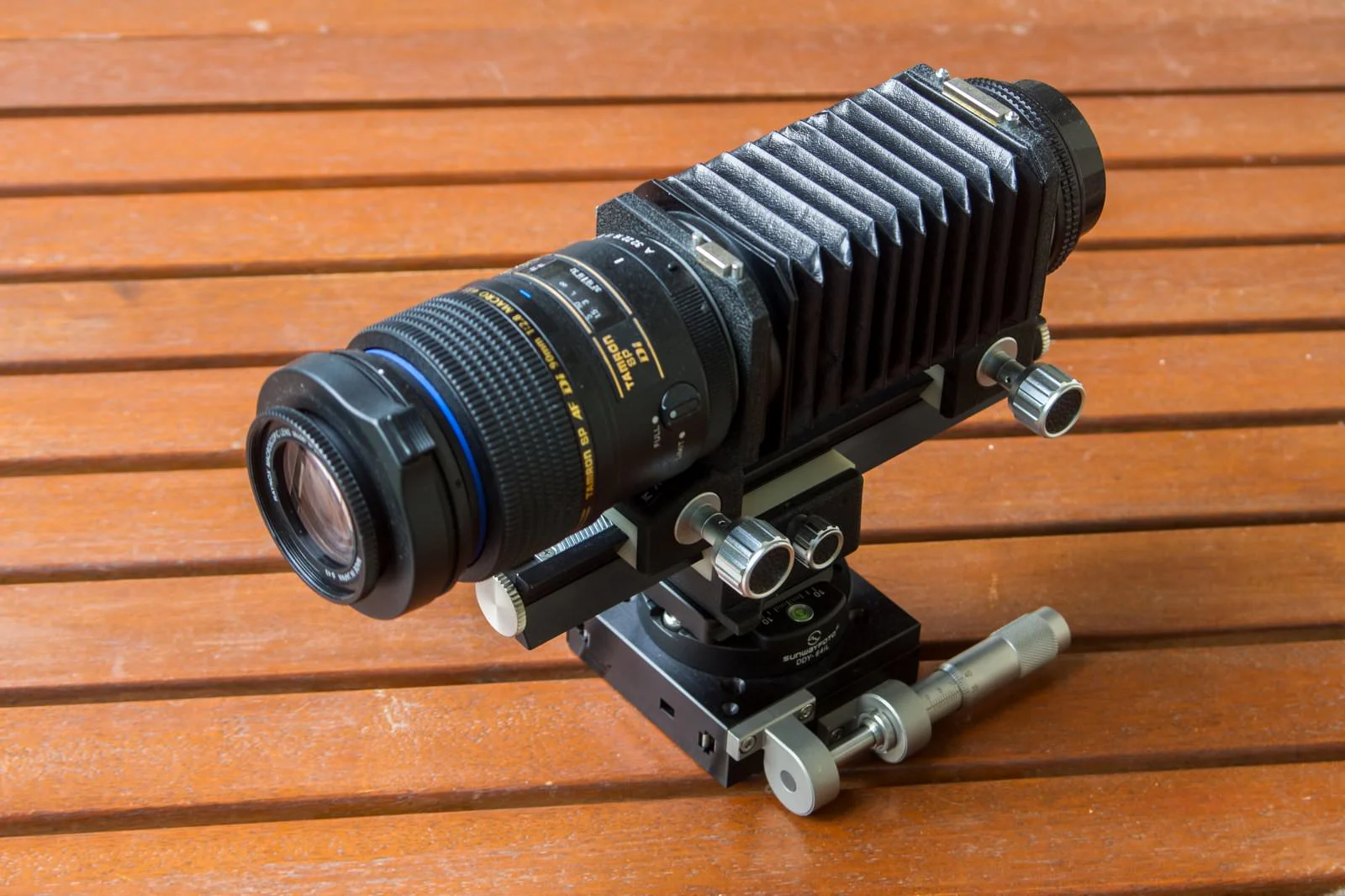
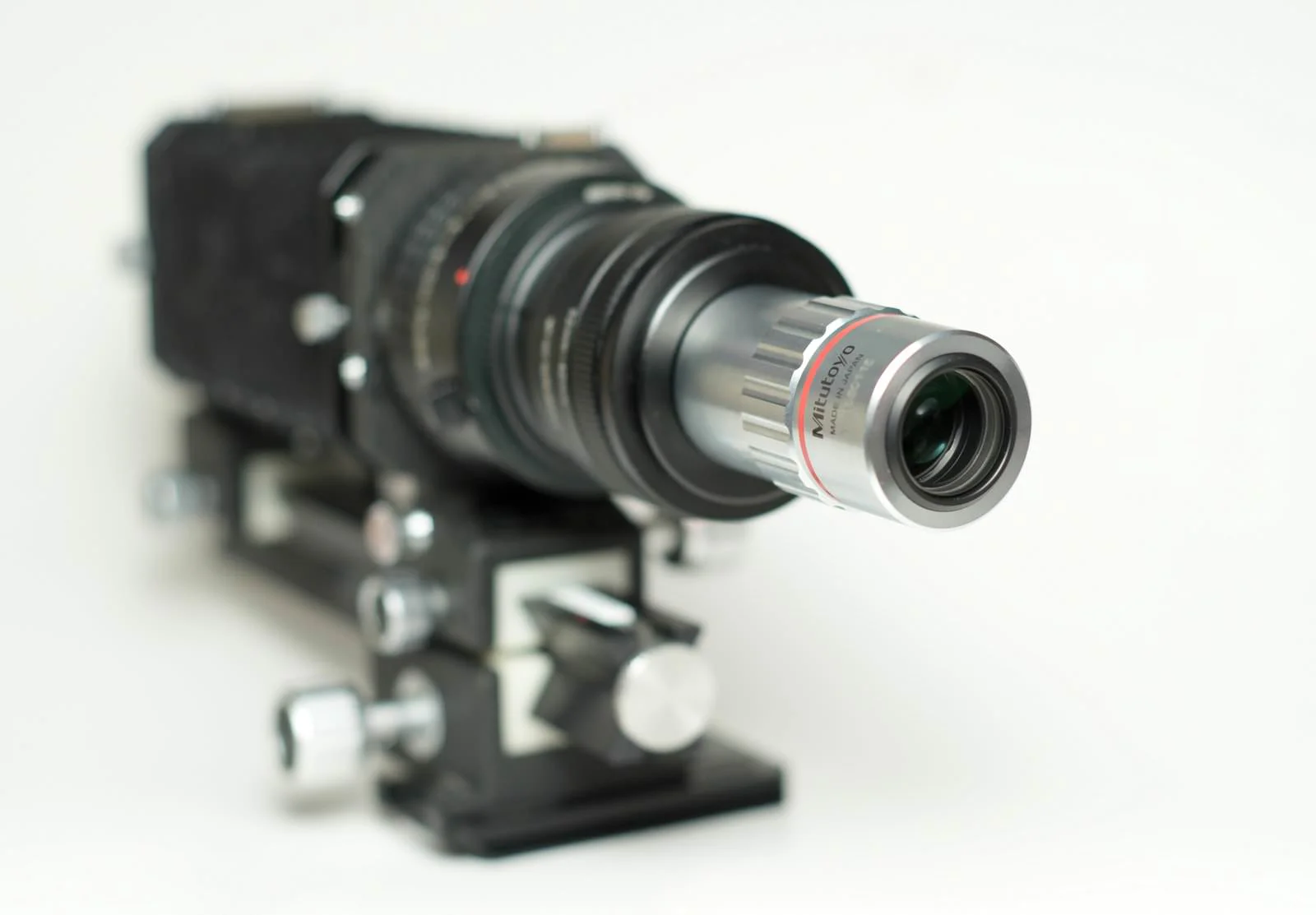
Of course, the camera and lens are on the list too. As a lens I used a reversed Componon-S 80mm. It performs very well and is easy to use up to about 1.5× magnification. But it’s a good idea to mount or improvise a hood on the front. Since I’m using enlarger lenses, as a hood I screw an m39 extension tube onto the outward-facing m39 mount. These tubes are older than I am and can be had for a price just above free.
Prepping for the shoot

On real field shoots we usually set up the rig in a suitable spot and then roam around to look for insects. Sometimes you have to carry the insect quite a distance without startling or dropping it. I remember missing many opportunities last summer because of mishaps during these steps :)
Another very important point is to secure the insect’s area from both sides. For this we use both clamps of the helping hand together and grip the leaf holding the bee at both ends. The cut plant wilts faster than you might think. After a few minutes of shooting, you’ll notice the leaf drooping a bit more in each frame, ultimately ruining the entire sequence. Securing it like this prevents sagging.
There was one more thing to do before placing the bee inside the tent: set the background. Normally I should cut a window in the back of the tent to use the natural environment as background. But to keep wind out and because I didn’t want to cut into it before ordering a spare, I didn’t. I grabbed the first flowerpot I saw on the balcony, with its flower, and laid it inside the tent. I placed the bee in front of it. I even put a black slipper at the very back—the first object I grabbed! With a dark object like a slipper, I block the light from the bright white back panel from entering the lens from the front and causing haze in the photo. After positioning the camera and lowering the tent flap, we’re ready to shoot.

Now, some might say, “Come on, you’re sipping tea or coffee on the balcony, cutting twigs and leaves, taking the insect, putting a flower in the background—how is this a natural shoot?”
You’re right, but I’m not actually saying “natural shoot,” I’m saying “natural light.” Truly natural shooting isn’t always possible. The place the insect chooses may not be a suitable surface for setting up the camera. It may be very hard—or impossible—to shield it from the wind. For instance, this bee was on a leaf nearly two meters high. And in the field, moving and setting up the camera anew for each insect is extremely laborious. We’ve tried it before. It doesn’t really work. It’s easier to run the mill with carried water. Apart from cutting a few small leaves during the process, we don’t harm nature or the insect. When we’re done, we place it back near where we found it, in a safe spot for it.

Focus stacking outdoors
Cloudy weather is an advantage in terms of light performance. If I’d been in direct sunlight, the tent’s thin fabric wouldn’t have been enough; I would have needed another layer of diffusion to soften the light.
Taking advantage of the bee staying calm, I shot around 500 frames over an hour. These belonged to a total of eight different compositions and magnifications. As always, a few went straight to the bin due to various issues. And again, each stack sequence had problematic frames of its own. Especially since I was pressing the shutter by hand, sometimes there was too much vibration, producing blurry images. I simply culled those and didn’t process them. Because I chose my focus steps precisely, the missing frames didn’t cause problems.

When we say sleeping insects, don’t assume they’re completely motionless. They’re not dead. Antenna and leg movements happen all the time. If we notice it in the moment, we pause the shoot and re-take the same frame after the movement stops. But most of the time you don’t notice until you’re at the computer. To illustrate these movements, I’ll provide the focus stack sequences for the sample photos as animated GIFs. These animations were created by showing the frames that make up the stack one after another. You can see both how the in-focus area advances backward with each shot and the insect’s movements.
 Macro focus stack sequence
As you can see, as the focus plane shifts backward, our distance to the scene changes and so does the composition. Before you start shooting, rack focus back and forth to study the composition. Don’t start unless you’ve checked beforehand that every area will remain within the frame. Otherwise you might end up with a bug whose arm or leg is out of frame.
The closer your working distance is to the insect, the greater the difference in framing and perspective between the first and last frames.
In the next shoot I set a higher magnification. To prevent loss of detail from diffraction, I used f/5.6 instead of f/8.

 Macro focus stack series
Sorry if the animated images take a while to load—the files are a bit large. But since I thought you’d want to see them, I didn’t want to shrink them too much. And finally, I’m adding one more photo at roughly the same magnification. No need to multiply the examples further.

 Note the antenna movements
In this last example, the antenna movements were disruptive enough that I had to crop just the area with the antennae and run a separate focus stack on it. I then overlaid the corrected antenna image onto the other shot and merged them. When it goes like this, processing the photo takes much longer than shooting it—but I think the results are worth it.
After filling most of the main card and then half of the spare card, my fiddling around—combined with a few degrees of warming toward noon—made the bee much more restless. Sensing that I couldn’t continue with stills, I decided to fill the remaining space with video. The shoot below came out of that. To see the details, I recommend full screen at 720p. The bee’s luxurious stretch as it wakes up is adorable.
http://www.youtube.com/watch?v=wEg9HzOa_0I
In the post I published before this one, on the topic of natural light—titled Natural light and a day of failure— I described how things can go wrong. Using the right equipment and having the right weather conditions play a key role in shooting this kind of photo. When everything else lines up, it all comes down to finding insects. Let’s see if luck will be on our side again in the coming days :)