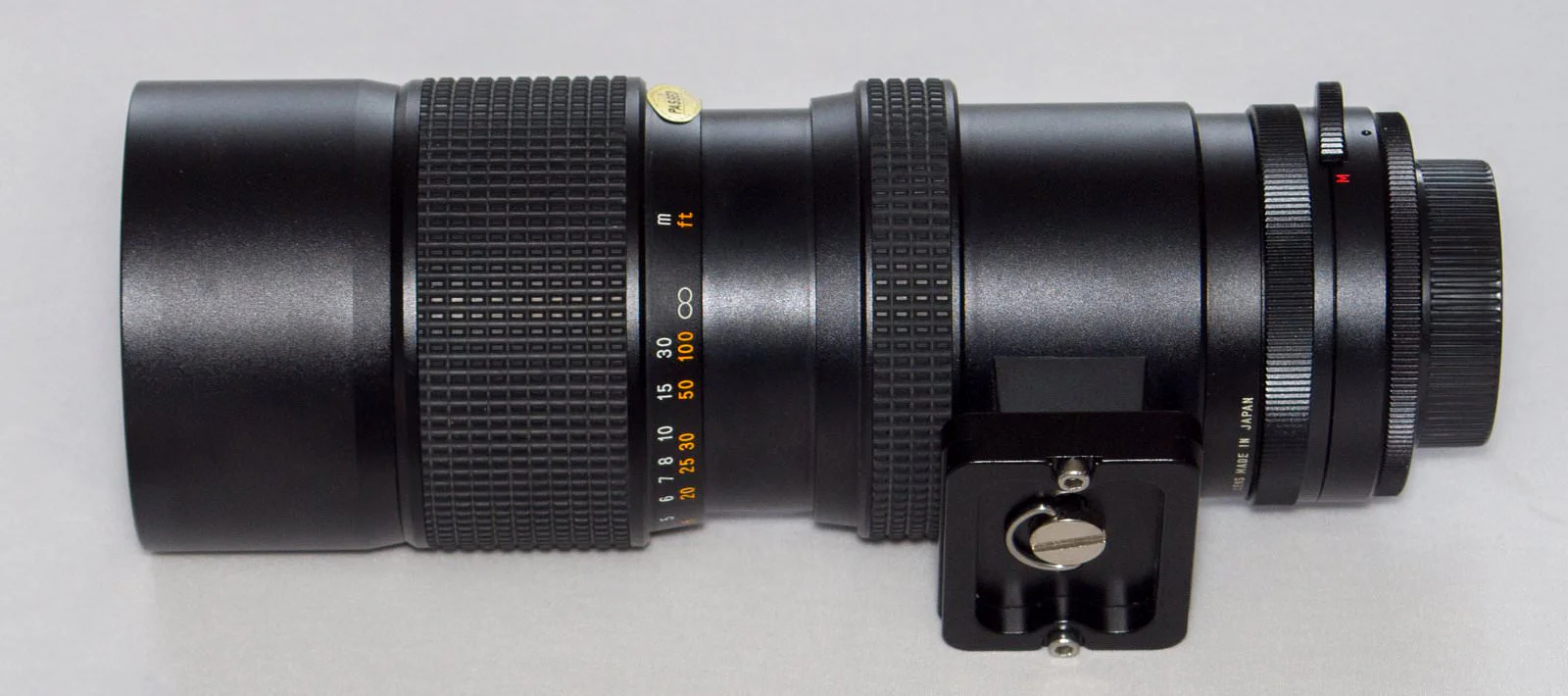
True macro lens
In the previous post I said that what defines a true macro photograph is the 1:1 magnification ratio. Of course, that statement was entirely about the definitional side of things. In practice, the path to producing striking photos doesn’t run through definitions.
In this article we’ll examine a true macro lens by talking a bit about definitions and a bit about important characteristics.

A macro lens differs from others with certain technical features, and we need to take a look at those.
Some say the “amount of magnification” in the definition should be loosened a bit. Because until not too long ago macro lenses were generally offered with 0.5X magnification, and among them are many models that etched their names in memory and are still sought after by those in the know. Even if I don’t call these true macro lenses by definition, I have to give them credit for the fundamental characteristics that come after magnification in a macro lens, such as sharpness and “flat-field.”
Plane of focus (Flat field)
The technical name of this topic is “Field Curvature.” In normal lenses, this can be tolerated to some degree and causes the plane of focus to be curved. Macro lenses, however, are designed to minimize this aberration—targeting “flat field” performance.
I can explain this as the in-focus region forming a geometric plane—something especially sought after in true macro lenses. In a normal lens it’s intended—or sufficient—that most of the sharpness be concentrated at the center of the image. With the aperture wide open, degradation toward the edges becomes more pronounced.


Resolution
This is the lens’s ability to render detail. As we force the lens to higher magnifications by various methods, we do obtain a photo that truly appears larger and closer. But beyond a point we can’t achieve better image quality. The lens can’t deliver more detail; the photo becomes increasingly blurry. This stems both from the optical limits of the lens and from the diffraction effect that inevitably appears as magnification increases and reduces sharpness. The portion directly related to the lens—that is, the level of detail it can transmit—we call the lens’s resolution.
By the way, we do the magnification push with tools like tubes and bellows. I’ll explain these later. In macro work we need to use the lens we have within the magnification range for which it’s suitable.
Note: Whether macro or not, most old lenses likewise can’t meet the resolution needs of new-generation high-megapixel cameras. For example, when we use a low-resolution lens on a 20 MP camera, we actually can’t get more detail than what a 5 MP camera could provide. Even though the photo is 20 MP, it may not look sharp when viewed at full size.
Resolution is a combination of many factors such as the optical design of the lens, the quality of the glass elements used, the effectiveness of their coatings, and assembly precision in manufacturing. It’s expressed with numerical values like MTF and lp/mm (lines per millimeter). Macro lenses carry quite high values compared to other lenses. We can’t call a lens good by resolution alone, but it’s an important parameter for a sharp image. It also gives clues about how far we can push that lens to higher magnifications and how much performance we’ll get on new-generation high-megapixel bodies.
Prime lens / Zoom lens
If our lens has a single, fixed focal length like 50 mm or 90 mm, it’s called a prime lens; if it has a ranged focal length like 18–55 mm, it’s called a zoom lens.
If we’re going to shoot macro, the lens in our hand should be a prime. Macro lens manufacturers also generally choose this route. Special lenses like the Canon MP-E 65 have complex constructions because they allow changes in magnification, but when we say true macro lens we should think of a 1:1 prime lens. If you ask how a 35 mm 1:1 lens and a 180 mm 1:1 lens both deliver the same 1X magnification, the difference between them is the minimum focusing distance, also called working distance.
With 180 mm you can magnify a bee to 1X from quite a distance, whereas with 35 mm you may have to approach within 5 cm and risk getting stung. On the other hand, the bee is the same magnification in both photos. Its size and detail in the frame are almost the same. But the perspective and background rendering will be quite different. While 35 mm brings the background and surroundings into the photo, 180 mm will isolate the bee completely from its environment. Also, lenses with shorter focal lengths can easily be pushed to higher magnifications. In short, the two lenses have different use cases. If you’re a macro enthusiast, you’ll want them all. :)
Beyond making our job harder with their heavy and bulky structures, zoom lenses have complex designs and more layers of glass. Every additional glass surface reduces resolution. That’s why I don’t prefer zooms in macro. While good results can be obtained under the right conditions, they’re not very appealing when there’s a chance for excellent results.
If you only have tele-zoom lenses and don’t want to buy a new lens, don’t despair. With a bit of support and good lighting, you have a chance to achieve high magnifications. You can still get good results. There’s a review on this topic. I recommend reading it:
/ucuz-zoom-lens-ile-makro-cekim/
It says “macro” on it?
The word “macro” on our lens doesn’t make it a macro lens. Some brands like to slap “macro” on just about anything. You may see zoom models like 70–200 macro, 28–300 macro, or prime models like 24 mm macro. Except for some special lenses, these typically achieve around 0.25X magnification and are far from being true macro lenses.
I’m certainly not saying they’re bad lenses. But they’re not suitable for true macro and will fall far short of the detail a macro lens can deliver. When buying a lens, don’t purchase based on the word “macro” on it without researching how much macro it actually means.