Aperture setting in macro photography and the diffraction effect

A lot of questions come up about aperture settings. At which value do we get better results? Should we open up, or stop down? As I approach the topic, I’m looking at it entirely from the macro-shooting perspective. In macro we generally work with a focus on detail. In portrait or landscape work, this level of detail may not be necessary.
Even if I want to keep the theory short, it’s hard to avoid it entirely. But since I’ve covered some concepts in earlier posts, I won’t repeat them here. Don’t worry, it’s not just concepts—we’ll see practical results too.
- Depth of field - Aperture - Effective aperture So if you feel a gap in any of the concepts listed above, it might be helpful to first take a look at these two posts:
Megapixel, sensor size, aperture, ISO (Entry-level concepts)
Why is depth of field so narrow? What is effective aperture? (A general look at aperture)
Is a stopped-down aperture sharper, or a wide-open one?
I see this frequently in photo shares. I even read it in some articles. To widen the plane of focus in macro, apertures are stopped down as far as possible. We then shoot at the smallest value the lens allows, like f/32. On some macro lenses we see f/64 and think it’s a superior feature. Or stranger still, when EXIF shows something like f/51 on a lens whose maximum is f/32, we assume there’s a malfunction.
The f/64 value comes from the “effective aperture” measurement. When a macro lens is focused at infinity, the aperture value we set matches the amount of light entering—i.e., it shows the correct value. But as we move toward minimum focus distance—i.e., as magnification increases—the light we take in decreases. Up to 0.5× magnification there isn’t a serious effect. But when we reach 1:1 magnification, in effective terms the aperture has reached f/64. So even if the lens shows f/32, we are actually working at f/64. We need to consider this effective value when choosing the aperture. Diffraction behaves accordingly.
Some camera bodies behave smartly and show the effective aperture in EXIF; others don’t. Since we typically use manual or reversed lenses, the body often has no idea what lens is attached. It’s better if we take over the “smart” behavior ourselves.
So is f/32 a bad thing? In my opinion, yes! No matter what magnification you’re at…
If we have no choice, we can use f/32. But our goal is “not to be forced into it.” We need to find a better method and work without stopping down that far. Otherwise what happens? Back to the theory first.
Diffraction
We need to go back a little to high school physics. Whether sound waves, water waves, or light, waves spread due to diffraction as they pass through a narrow opening. The narrower the opening through which our subject—light—passes, the greater this effect.


So, if the image that should be focused and point-like is affected by diffraction due to a small aperture, the image produced on the sensor ceases to be point-like. If we think of this point as one pixel of a detail, instead of giving a sharp, crisp detail, like the ripples from a stone thrown into water, this pixel’s image spills into neighboring pixels. Imagine every pixel that forms the image affecting its surroundings this way. Not a situation we’ll enjoy.
Diffraction – Sensor size
The impact of diffraction is directly related to sensor size and megapixels. Imagine the distortion in the photo falling on the sensor. If the distorted point of light is small enough to fit inside a single pixel, then it can’t affect neighboring pixels. But on a small sensor or a high-megapixel camera, there may be 10 pixels where that tiny light falls. Or, as we stop down, we increase the diameter of the blur/diffraction pattern. In that case all the lights falling on nearby pixels are intermixing. The high resolution your camera offers has been trashed by diffraction.
Diffraction tests
Now back to the main question. Does all this talk have practical importance?
We need to decide according to our purpose and constraints. If we’re going to use the photo small on a web page or social media, we won’t notice diffraction. For small usage, there isn’t much to calculate—the original large image’s degradation doesn’t concern us.
As another example, if we have no chance to do focus stacking on the insect we want to shoot, we’ll be forced to stop down to increase depth of field, entering the diffraction zone.
Best to test and see the results.
I decided to test using three different magnifications: 1×, 2×, and 3×. I wanted to use a different lens system for each so that effective apertures would differ. I didn’t actually measure the effective apertures—measurement is a bit of a hassle—and rather than confusing with numbers I want to convey the gist. We’re already talking enough concepts.
In macro lens tests, we should choose a subject with very fine details so we can easily see differences between shots. For this, butterfly wings are commonly used—because of the tiny scales on them. Those scales have endless detail, even under high-magnification microscope objectives. For the same reason I used the wings of a silkworm moth and a ricaniidae hopper. I didn’t do sharpness tweaks, etc. in the photos. I only made small exposure compensations among the series to neutralize the exposure differences that come from using different apertures.
1× magnification, Tamron 90mm
Our insect is a bit small for 1×—about the size of my index fingernail. But that’s not important; our goal isn’t to showcase it but to see the aperture’s effect on detail. If we place side by side a series of photos taken from f/3.5 to f/32, we get this view:


At f/3.5 the depth of field is very narrow; sharpness is not bad. It’s very clear that sharpness peaks at f/5.6 and f/8—indeed f/5.6 looks a bit better. At f/13 diffraction has started to wipe out details. In my opinion f/18 yields an unusable result. f/32 is an outright disaster; the photo looks like watercolor. High-frequency detail can’t get through the very small aperture. Both glass transmission and diffraction have badly hurt us.
There’s something else noteworthy. Surprise! Our sensor dust is on full display! While dust shadows blur into bokeh at wide apertures, they appear small but hard-edged when stopped down. I didn’t do any Photoshop dust removal so they could be seen.
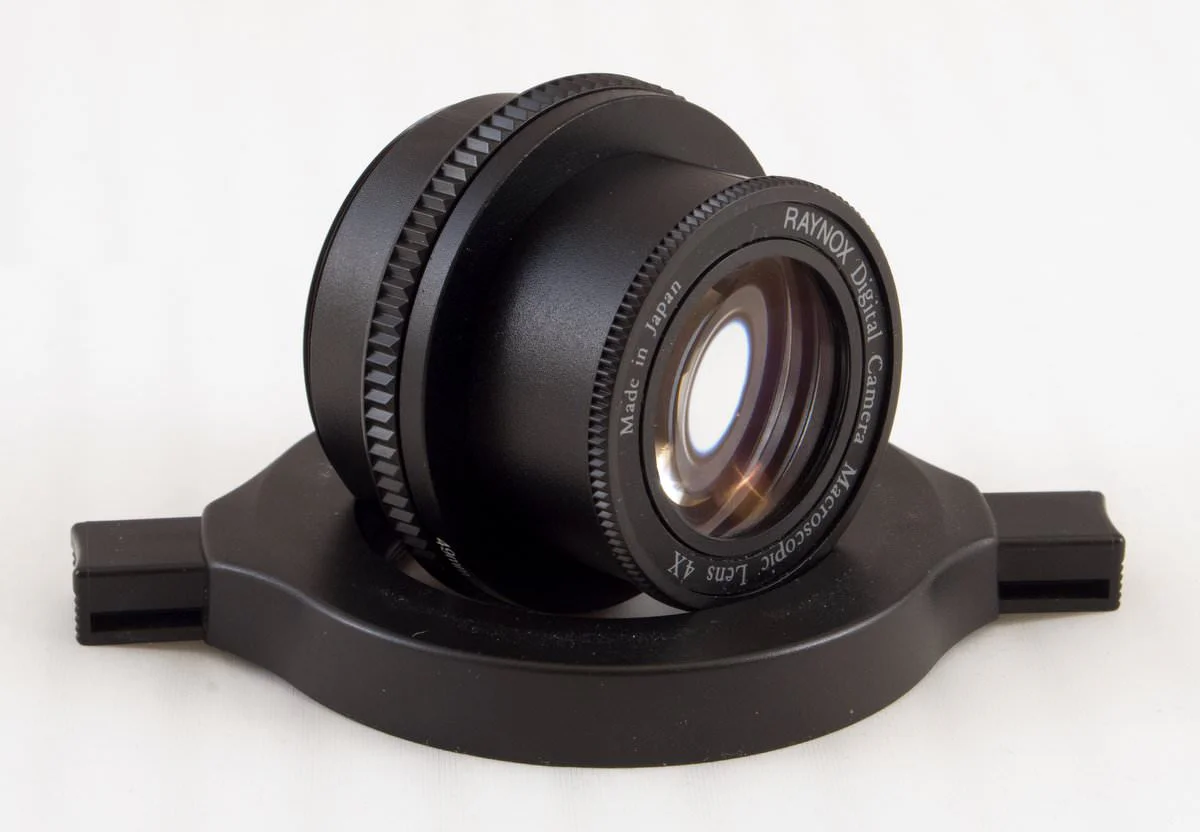
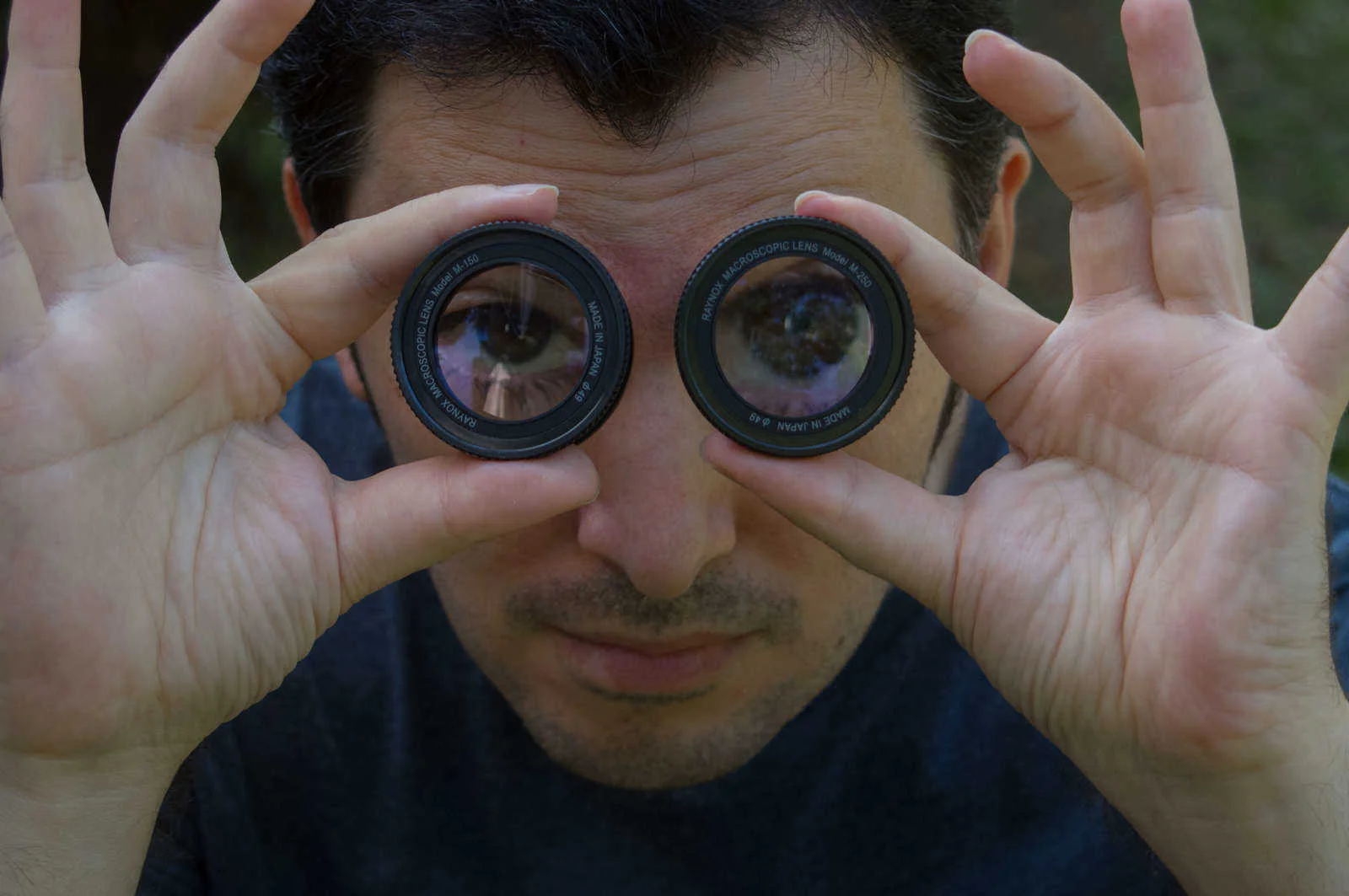
2× magnification, Tamron 90mm + Raynox DCR-250
This pair I love doesn’t actually give exactly 2×. Our magnification is 1.8×. Don’t think it’s the same lens—when we attach the Raynox, we do some odd things to the optical design.
I mentioned that effective aperture is used in depth-of-field and diffraction considerations. In fact, calling it “in calculations” is wrong, because this isn’t a virtual effect—it’s a real condition reflected directly in the photo. Since we place a magnifier in front of the lens, we admit light gathered and intensified by the magnifier. At the same nominal f-number, about three times more light enters. With the Raynox attached, the effective aperture is actually wider (i.e., a smaller f-number) than what the lens shows.


Although Raynox increases magnification, it gives us a brighter viewfinder, shorter exposure times, and diffraction that shows up later (at smaller apertures).
Even though we doubled the magnification, we didn’t see diffraction at f/10. If the effective aperture hadn’t changed, we would’ve seen serious softness at f/10. Front-mounted close-up add-ons like the Raynox have this advantage. If we had used a teleconverter, as magnification increased the opposite would’ve happened. The downside of the Raynox is that it shortens working distance considerably. A teleconverter doesn’t change working distance.
3×, Componon-S 50mm
We use our well-regarded 50mm enlarger lens reversed at 3× magnification. The target is again the hopper’s wing. Let’s line up the full-frame photos side by side.


While we got sharp results at f/10 with the Tamron + Raynox, now we’re limited at f/8. Why? Because magnification increased. The effective aperture formula is as follows:
Effective Aperture = Lens Aperture × (1 + Magnification / Pupil magnification) You can roughly take pupil magnification as 1. For details, see the links at the top.
So if we use f/10 for 1× magnification, 10 × (1 + 1) = f/20. For the 3× we tested: 10 × (1 + 3) = effective f/40. That means plenty of diffraction.
Conclusion
Detail lost due to diffraction is an optical problem and cannot be recovered by sharpening algorithms. Software sharpening merely increases existing contrast to create a fake sense of sharpness, but it can never restore the real detail that’s gone. Therefore, the best solution is to shoot with the correct aperture value from the start.
As magnification increases, we need to use lenses at somewhat wider apertures. But very wide open doesn’t yield good results either. In trying to avoid diffraction, we might move into the region where the lens is soft. This is where lens quality differences show. Every lens has a value known as the “sweet spot” where it delivers maximum sharpness. If magnification allows, using the lens at its sweet spot is best. But if we’re working at a magnification where diffraction starts at that value, we may need to open up a bit.
Lenses used for high magnification—like the Componon 35mm, Rodagon 28mm—give their best results wide open. Knowing your lens and keeping this in mind when choosing aperture is important.
Note: There are old lenses that are quite poor in sharpness yet create an aesthetically “dreamy” look. These are used successfully in macro and close-ups. In such cases the goal is framing and aesthetics rather than detail. For example, the Meyer Trioplan 100mm f/2.8.
Additional test
What if we’re not doing macro? Does diffraction affect results in everyday shooting?
I did a simple test on a detailed subject—a curtain texture—from 4 m away. I used f/6.3 and f/32.


Wishing you diffraction-free shoots :)