Wide-angle macro photography with daily lenses
If you’ve been following Macro World, you’ve probably noticed: I’ve been sharing only wide-angle shots for a while. My high-magnification microscope etc. work is on pause. I’m not sure if that’s a good sign or a bad one, but for now I still have some wide-angle goals I haven’t hit—and I’m having a good time.
I’ve been a bit lazy this year. Just setting up and tearing down the studio rig is a project on its own. The wide-angle macro technique I discovered right around this time did me a world of good. With a light rig and handheld, single-frame photos, I also cut out the exhausting computer phase.

Before we go on, if you haven’t read it yet, I recommend my post explaining the details of the wide-angle technique, Wide-angle macro shooting – Laowa 15mm f/4.0. I dug into why it appeals to me so much and did test shots with the Laowa 15mm.
Other lenses?
The Laowa 15mm is the first lens specialized for wide-angle macro. It’s very sharp. But it has two challenges.
- It isn’t cheap and I don’t own one—I borrowed it for tests.
- And it’s a bit tricky to use.
In near-focus wide-angle shots we use stopped-down apertures like f/16.
So I started looking for lenses that, while not direct Laowa replacements, I could use at close range and enjoy. There isn’t much info out there. All I knew was this: by putting a tube behind any lens, we can force it to focus closer. We already do this to adjust magnification on macro lenses.
I’ve used wide-angle lenses with macro tubes many times, but the lens was always reversed—aiming for high magnification. With the lens mounted normally, tube length becomes a very sensitive matter. The wider the lens, the more we’re talking millimeters for tube length. We’ll see that in a moment…
With that in mind, as usual I started with what I had. I don’t have many wide-angle options. I decided to hit the road with my very trusted Samyang 14mm and my veteran Pentax 28mm.
Samyang 14mm f/2.8 IF ED UMC
With its head-spinning string of letters and game-changing sharpness, the Samyang 14mm stole hearts the moment it hit the market as a full-frame ultra-wide. It delivers impressive sharpness even wide open—excellent for astrophotography.
It’s rectilinear. Lenses this wide often start to give a fisheye look—straight lines near the frame edge bow and bend. The Samyang 14mm doesn’t. Its optical design corrects for that in-lens.
If I can get it to focus close by putting a short tube behind it, I feel it could compete with Laowa. Who knows how sharp it’ll be stopped down…
I used Pentax bodies before Sony, so my copy is in Pentax PK, and I’ve been using it on Sony with a Pentax adapter for a long while without issues. I also have plenty of Pentax gear—including macro tubes. I slap the shortest tube I own, 12 mm, behind the lens and head out, eager for the first shot.

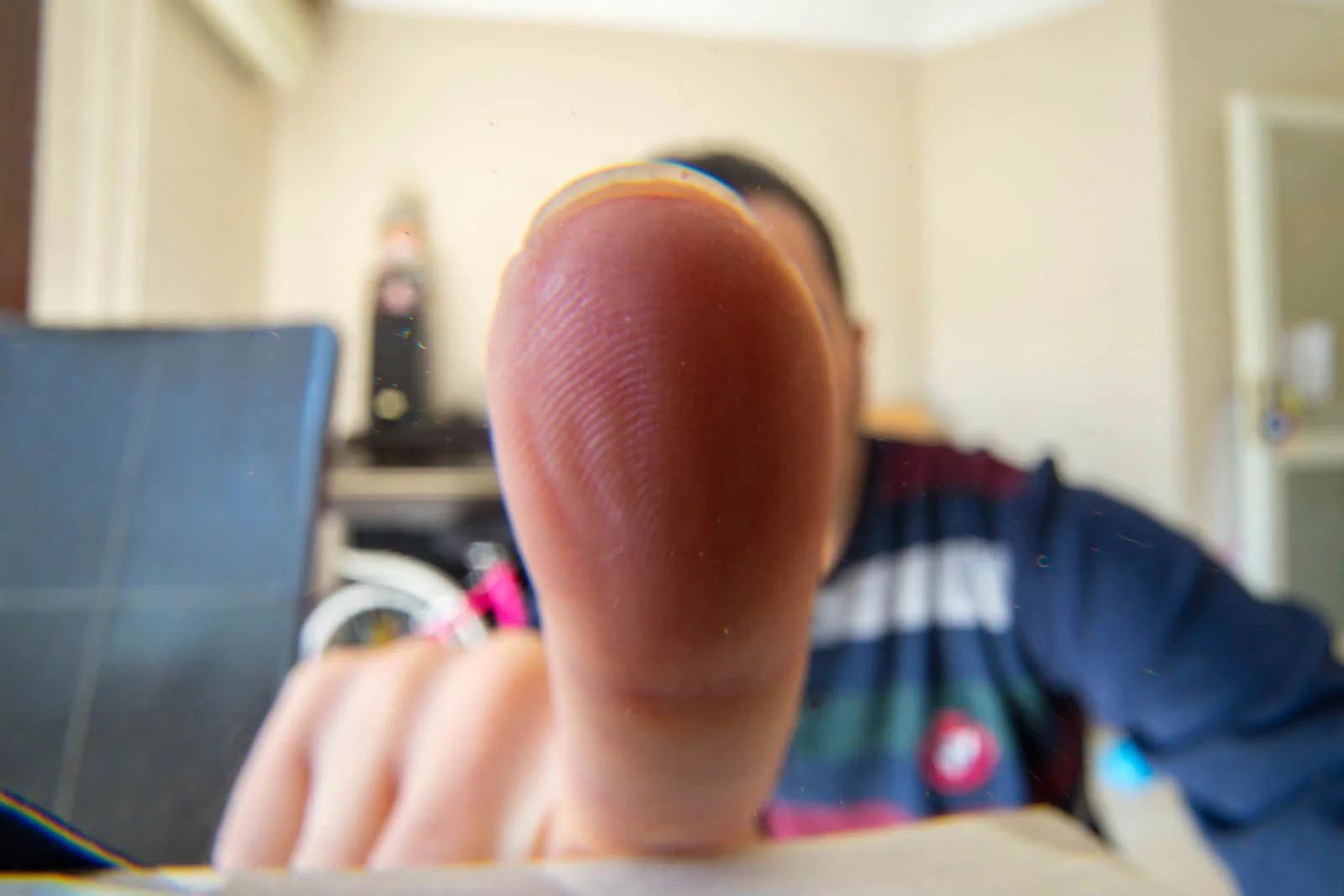
But that shot can’t be taken. The 12 mm tube I mounted to force close focus is so long that the focus distance ends up inside the front element! In the photo above I’m touching the front glass with my finger. Notice how the dust specks on the surface are nearly in focus and easy to see. But there’s no truly sharp zone—because focus sits somewhere inside the lens.
There’s also an absurd amount of CA—color fringing—especially at the borders, with blue/red halos running away with the show. I’ll set that aside for now—maybe it can be corrected. The priority is getting focus. And the only fix is an even shorter tube—just 3–5 mm!
I pocket my disappointment and sit down at the computer. How do you make a short macro tube?
There are lots of DIY projects: cut down old tubes and glue on bayonet rings salvaged from other lenses; hunt for special ultra-thin macro tubes for Canon/Nikon—but even those might only move focus forward by 1 mm… No real solution!
Helicoid
There is a solution: a helicoid. For those unfamiliar—a helicoid is a macro tube that lengthens and shortens as you rotate it. You can add as little as a tenth of a millimeter if you want. Our lenses’ focusing mechanisms are all built on helicoids—turn the ring, the front moves out, and you focus closer. That’s exactly what we want.

Luckily there’s another fix. Mirrorless systems never run out of tricks. The answer is helicoid adapters.
I need an adapter to mount a Pentax lens on a Sony body—and it needs helicoid travel. Research begins. Turns out “helicoid adapters” do exist. Oddly, nobody made one for Pentax. There are Canon, Nikon, M42, even Leica… but no Pentax.
After being annoyed for a while, I remembered that Pentax lenses are also easy to use on Canon, so I ordered two items.
- Pentax–Canon converter
- Canon–Sony helicoid adapter
In other words, I’d first “turn” my Pentax lenses into Canon with the adapter, then “turn” them into Sony via the Canon–Sony helicoid.
There’s a one-month wait before they arrive. Of course I didn’t sit idle—I thought of other solutions. Digging through drawers turned up a macro-focusing teleconverter.
Vivitar Macro Focusing Teleconverter 2×
I really like this old Vivitar. I use it as a “mixing board” when I’m trying to connect odd bits of gear. In normal use, it turns a 50 mm standard lens into something like a 100 mm 1:1 macro. Emphasis on “like”—don’t expect miracles.
But it adds a helicoid. Rotate and it extends, letting you focus closer. If I mount the Samyang on it, I get [0–∞] focusing. The downside is something I don’t want: my 14 mm field of view gets doubled to 28 mm equivalent. I’ll lose a big chunk of the wide-angle feel.

Looks like a beast, doesn’t it?
Exactly—a straight-up monster to insects. The last look we want. That huge front element both scares subjects and makes lighting hard. Expect a big, ugly shadow in the frame. But that’s how this lens is. The Laowa 15mm too, to be fair. Both are monsters that way!


At first glance, it kind of works. But once the excitement settles, it’s clear it doesn’t. The corners fall apart. CA is awful. Magnification is insufficient. In short—not compelling. Phones can do this much. And I already have a small, light 28 mm. Rather than make a 14 mm behave like a 28 mm with a teleconverter, I might as well use the real 28 mm—better, in fact.
At this point, we jump a month—orders in hand.
I mount the Canon converter and then the helicoid adapter behind the Samyang and head out, eager for the first shot. Sound familiar? :)
That shot can’t be taken either. For some reason, Samyang designed this lens to project a rectangular image instead of circular. The Canon adapter rotates the Pentax lens slightly. Then, once on the helicoid and body, this skewed rectangle shows up on screen.

Sharpness isn’t bad. Compared to the teleconverter setup, it’s much improved. But the corners… I can’t tell if the rectangular image was for cost or performance, but it breaks my use case. One last thing to try: set the full-frame body to APS-C mode to crop the edges. Doing that with a wide-angle is basically killing the photo.
That setting rattles me psychologically, too :) If I could be getting a 24 MP wide-angle image, why am I shooting a narrow 10.5 MP file? Why did I pay that much for the body?!


So—meh. The CA still kills the mood. The angle ends up ~14 mm × 1.5 = 21 mm. Wider than the TC setup, yes, but the image quality still doesn’t excite.
I have to drop the Samyang 14mm from close-focus options. I’ve put it through enough. Back it goes to its daily-use glory.
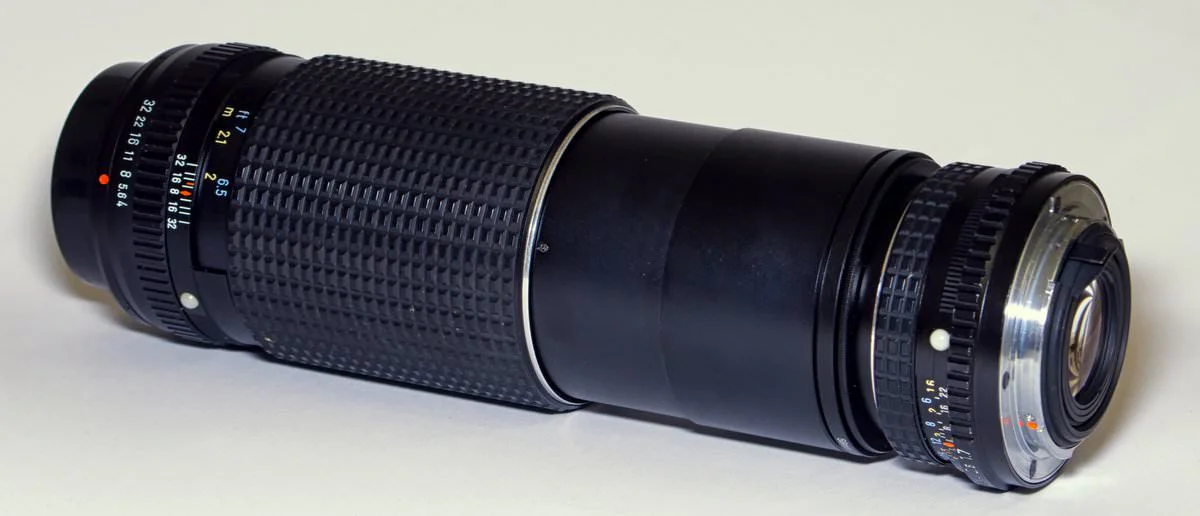
Pentax SMC-M 28mm
When I first discovered the world of “extreme macro” years ago, the first lens name I heard was the Pentax 28mm. You’ve surely seen Thomas Shahan’s jumping spider shots with a reversed Pentax SMC-M 28mm on tubes. I grabbed one to copy him and had my first thrills with it.
Old manual lenses are like tanks. Treat them well and they’ll serve for life. Now we’ll add wide-angle close-focus duty to that.
The shots with the Samyang 14mm + 2× TC showed that 28 mm would give a sufficient wide-angle feel. But note: I’m talking full-frame bodies. Bigger sensor, wider view—assuming the lens covers it.
Now rewind to the pre-helicoid-adapter era. The 12 mm tube in front of the Samyang 14mm brought focus so close it fell inside the lens. I knew 28 mm wouldn’t have that issue. I grabbed the extension tubes and tested right away.

My eyes went wide the moment I saw the result. This was the sharpness I wanted. Click to zoom in on the details.
Naturally, you get curious. If 12 mm is this good, let’s try the 20 mm section. Even both together for 32 mm.


At 20 mm and 32 mm, the results aren’t as strong. A slight loss of sharpness is fine, but the background getting mushy breaks the wide-angle character. The hallmark of wide-angle macro is showing the subject with its environment. If we can’t bring the background in, the method loses its point. If that were the goal, we’d use our true macro lenses—which are much sharper—rather than a 28 mm.

So the ideal would be a tube system that starts at 12 mm and can stretch to 20 mm on demand. Yes—I’m talking helicoid.
The plan we had for the Samyang—convert to Canon, then mount to a Canon–Sony helicoid—works the same here. Plus, we add a 12 mm macro tube right behind the lens. Now the lens has exactly what we want: a tube system that starts at 12 mm and extends as needed.
In other words, we’ve got a variable-magnification wide-angle macro lens that we can tune to the subject size or framing width we want.
Since the tests were done indoors on a static rig with low light and long exposures, I needed to see how it performed outdoors, handheld.


The Pentax 28mm delivered. I’d found my first wide-angle lens.
Let’s keep looking. The first idea is to go a bit wider. Fourteen millimeters is very wide; 28 mm is not bad. Something in between would be nice. Standard focal lengths between them are 24 mm and 20 mm. Twenty sounds great—but it’s pricier than 24s. A 20 mm isn’t something I can “test and shelve” cheaply. I’ll continue with an inexpensive 24 mm.
Starblitz 24mm and Miranda 24mm
After a brief search, two lenses on sale caught my eye. Not much info on performance. Expectations low, but the chance of a nice surprise is tempting. I’ll take the risk and try both.

Both are cheap and can focus fairly close. Each is labeled MACRO but is actually quarter-macro—about 0.25×. With a helicoid we’ll push that higher.

The Starblitz is M42. To use it with the Canon helicoid, I add an M42-to-EOS adapter at the back. The Miranda—who knows. Even the seller didn’t know its mount. Thankfully my adapter drawer is a treasure chest. Turns out it’s Canon FD, and with an FD-to-EOS adapter it’s easily made helicoid-ready.


Test shots are positive. Still, they’re not as sharp as the Pentax 28mm. With fewer aperture blades, hexagonal bokeh stands out in the background. Used right, their wider field than the Pentax can produce pleasant photos.
The samples above are from the Starblitz. The Miranda isn’t much different—very similar lenses. Hopefully I’ll revisit them and add more samples, because right then I met a performance monster. After that, I hardly put it down. The other lenses were forgotten.
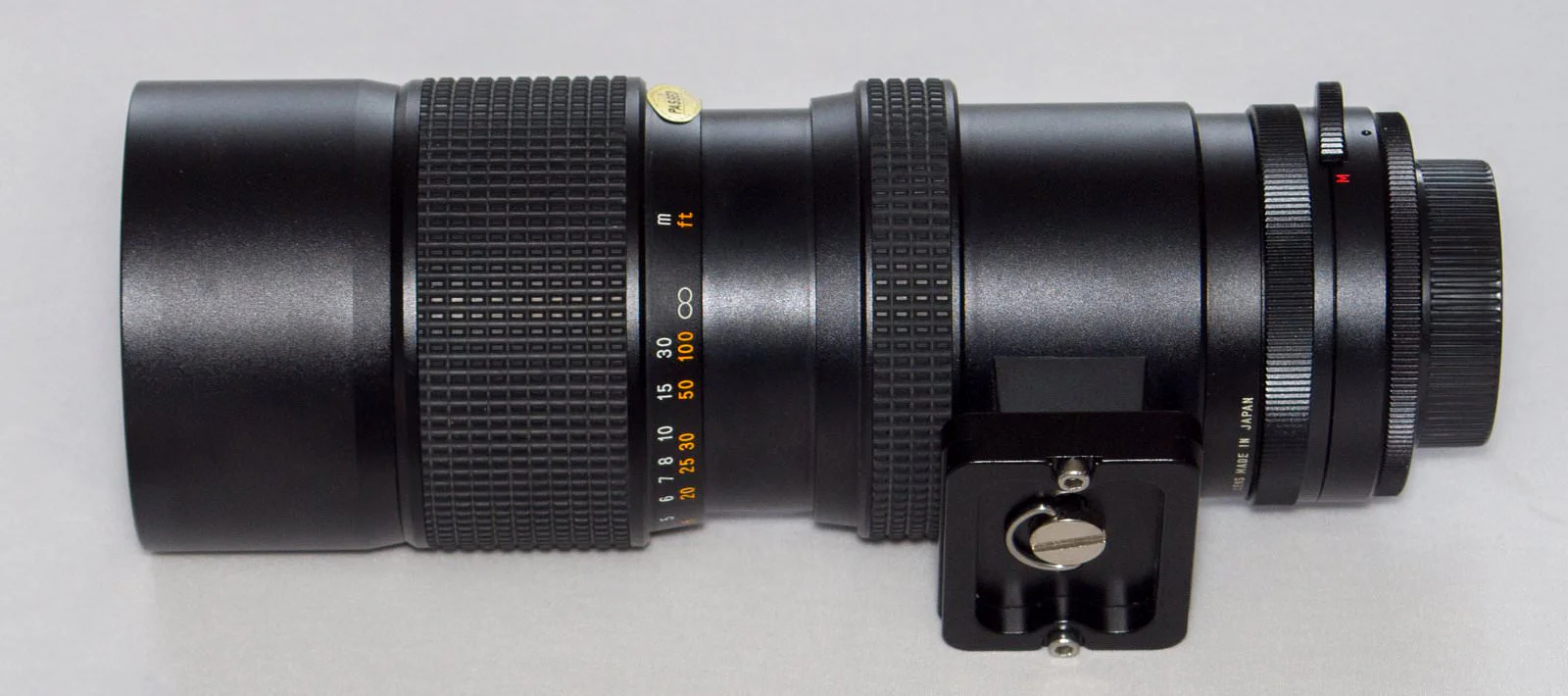
Nikon 20mm f/4.0
“They nailed it.” That’s the only thing to say about this lens.
Checking http://www.photosynthesis.co.nz/nikon/serialno.html, mine was made between 1974–1978. I’m a ’75 model myself, so we might be the same age. It’s stayed pristine to this day—and looks ready to outlast me.

I’d had my eye on it for a while, but I kept postponing to avoid customs hassle. When it became clear PayPal was shutting down in Turkey last summer, I grabbed one at the last minute.
There are many 20 mm variants. The modern ones are f/2.8. But I want fully manual with an aperture ring—and as small as possible. I don’t need speed this time. I’ll be at f/16. If it started at f/8–f/11, I’d kiss it on the forehead. Tiny glass, tiny lens. And cheap.
After the first tests, the lens floored me. Of everything so far, the 20 mm gives me the most joy in wide-angle close-ups. The magnification/working-distance balance is spot on. Lighting is easy. On to the sample album.





The Nikon 20mm is also a fantastic everyday lens, so it’s become the most useful lens in my kit. Lately I’ve been carrying only the 20 mm wherever I go. Whether close-ups or landscapes, the comfort of not swapping lenses is priceless. Helicoid adapters make that possible.
Wide-angle close-up technique
To wrap up, a bit on technique. As with everything, there are tricks. The one thing I’m sure of: compared to other macro methods, wide-angle is easier.
We use flash for lighting. But here it works better as fill, not the key. Use natural light as much as possible, and light just enough to nudge the subject forward and tame the shadows. In fact, it’s almost mandatory.
Since the background becomes a major part of the photo, it has to match the subject aesthetically and technically. Very bright or very dark backgrounds can look odd. To manage this more easily, we need a fairly large diffuser on the flash. The larger the emitting surface, the more effective the diffusion and the more natural the transition.

Running on two AA batteries, I use the Meike at low powers between 1/128 and 1/32 for wide-angle shots. Although it supports TTL, I prefer manual—it’s easier to dial in a gentle effect.
Another advantage of the Meike is continuous light—it has a built-in LED. You can use it like a flashlight to find insects at night and to see them for focusing. It’s bright enough even with the diffuser attached.
You can DIY a diffuser instead of the one in the photo. I took the easy route and ordered this from China. It’s like a bag: you slide the flash inside. It works well, and it has some smart details worth listing—handy when you’re adding similar features to your own creations.
-
A small elastic pocket inside grips the flash head and provides a first softening pass with its white fabric.
-
The upper inner surface of the bag is lined with a reflective metallic layer—bounces upward light back down to boost efficiency.
-
Dark outer panels on top prevent the flash from blinding you.
-
A second, thicker patch on the inner lower face sits near the flash head—right where the “hot spot” is—and helps spread that intensity to minimize specular reflections on the subject.
-
With a flexible wire frame, it folds figure-eight style—like a pop-up tent—into a small zip bag. Takes no space; super portable.

Back to the technical pros of wide-angle—let’s list the conveniences first.
Why wide-angle is easy
- Very deep depth of field. Getting the focus zone where you want isn’t hard. You can even photograph a flying bee without looking through the viewfinder.
- Less at the mercy of weather. With flash, you can compensate for low light and wind.
- Wides are less sensitive to shake, so 1/30 s is workable.
- You work with a light kit.
- Handheld means no setup/teardown. Bend, shoot, stand, move on. I’ve done 600 frames in a day—never come home empty-handed.
I won’t call the rest “difficulties”—let’s call them “tips.” My suggestions:
Tips for shooting wide-angle
- Keep the aperture around f/16—it strikes a nice balance between sharpness and a sufficiently clear background.
- If you push the lens to focus closer to enlarge the subject, you’ll quickly lose the background—and with it, the wide-angle look. For closer work, you may need f/22. Conversely, when you step back, you can open to f/11 for extra sharpness. As focus distance increases, it’s easier to keep the background crisp—so even a bit wider aperture still holds it.
- On classic DSLRs, stopped-down apertures mean a dark optical viewfinder. Newer bodies may give a brighter live-view that helps with focus. Mirrorless bodies are born for this: bright EVFs, focus magnification, and focus peaking make manual focus a breeze.
- You may need higher ISOs due to the aperture. I work around ISO 800–1600. Newer bodies are cleaner at high ISO and have an edge.
- Speaking of bodies—use full frame to get the full wide-angle effect. They give ~1.5× wider view than APS-C.
- Use flash always—even in bright sun—to soften shadows.
- Don’t let direct sun hit the subject. If you can, shade it with the diffuser; if not, use your body’s shadow. Otherwise you’ll get unrecoverable glare and color loss.
- Set flash power to balance foreground and background light. A couple of test shots help—especially if your own shadow is in frame.
- When ambient drops—clouds, evening—don’t blast the subject with flash. Raise ISO or lengthen exposure to hold the balance.
- Don’t forget spare flash batteries.
- Give the background at least as much thought as the subject. Sky and surroundings can matter more to the photo’s appeal than sheer sharpness.
- Unusual angles supercharge the wide-angle effect. From ground level pointing up can give a “bug’s-eye view.” Be open to these rule-breakers.
- Having a size-known element in the background—say, a person interacting—boosts perspective and interest. You’ll see plenty of people-in-frame examples above.
- And of course—try every wide-angle you have.
Final word
There will always be lenses I want to try. Next, I’d like to give priority to a fisheye. We’ll see when the stars align.
Before I forget—just as there’s “extreme macro” in regular macro work, there are “extreme wide-angle” examples too. They’re made with a technique many photographers don’t know: the relay-lens method. I’m still in the crawling phase there. Tests are ongoing. If it matures enough, it’ll get a post here.