Macro photography with the 18-55 kit lens

I had long been paying attention to Murat Öztürk—whom I met on Facebook—for his macro work using a reversed 18–55 mm kit lens. After seeing these successful shots, which practically contradicted my oft-repeated statement in many places that “zoom lenses are not a good idea for macro,” I felt the need to run some tests with the 18–55 myself and write about it.
After I finished the test shots for this article and was chatting with Murat, it turned out he had already prepared a write-up on the topic. He kindly sent it to me as-is with plenty of visuals, and we’re sharing it here. It doesn’t limit itself to just the 18–55 lens; it also touches on natural light, flash use, focus stacking, and other technical topics—one stone, many birds. I thank him and hand it over:
Note: After Murat’s article, I’ll add a few of my own notes and sample shots.
Macro with a kit lens
Murat Öztürk
Macro shooting with a Canon kit lens — Murat Öztürk
Kit lenses are often seen as useless. But with the right light and technique, it’s not impossible to get good results with them. I reversed my 18–55 lens and got some nice macros, and after the questions I received, I wanted to share what I’ve learned in this article. For those new to macro, those who don’t have or can’t buy a macro lens, I’ll try to explain—based on my research and the methods I developed myself—how you can shoot quality macros with 18–55 kit lenses using simple methods. In truth, there’s no such thing as useless gear (okay, with the odd exception :) ); what you need is the right light, a pleasing composition, and patience. When those come together, you can get nice frames even with an 18–55—reversed or not. Sample photos…


Now I’ll try to answer the question: “How can we shoot quality macros using the built-in flash or an external light source with our reversed 18–55 kit lens?” Before that, there are a few important points to keep in mind; I’ll list them.
- Aperture setting: Since the 18–55 kit lens has no manual aperture ring, no matter what we set, the aperture returns to fully open when we remove the lens from the body. That results in a very thin depth of field when reversed. To keep the aperture where we want it, after setting it we need to press and hold the depth-of-field preview button (on Canon it’s next to the lens release—on Nikon/others I’m not sure) while removing the lens. Looking into the lens, you’ll see the blades remain at the chosen setting. Then attach the lens to the camera with a reverse adapter and you’re ready to shoot.
- Light: Light is the most important factor in any photo. Using light correctly in macro will yield the best results. For flash or other light sources, we need to diffuse the light—that is, soften the harshness. Otherwise, even with a nice composition, specular highlights on the subject will make the photo look crude.
- Vibration: Almost everyone knows the effect of vibration. In macro—where magnifications are high—shake becomes a big problem. In flash shots I haven’t seen much issue with vibration; at 1/200 s with flash, shake isn’t a problem, but using a remote is still wise, because a slight shift in framing can waste a whole stack (focus stacking). With natural light or a desk lamp, light may be insufficient and we may have to shoot at very low shutter speeds. So we need a solid tripod and a remote release. On top of that comes mirror slap. In some shots we may need 3 s, 5 s, or even slower; even the slightest shake during mirror movement can affect the photo. For that we can use the camera’s “Mirror Up” function.
At high magnifications with a reversed lens, we may need to get very close to the subject. With a normal flash pop, you may find the subject dark; the reason is the light hitting the lens and leaving the subject in shadow. If you have an external flash, it’s easier to direct light from above to where you want with a suitable diffuser. If not and you want to use the camera’s flash, you can still make a simple attachment to bring the light down in front of the lens. I’ll show photos of a simple rig I made from a medicine box. The only must-have is aluminum tape. The other parts are up to your imagination—you can design it however you like.


Setting the background color
All good—but will the background always be this dark? The fix is simple: place an object of the color you want in the background. A few key points: at 55 mm, the background object can be a little farther back and still give the color you want, but at lower focal lengths (18–24 mm) the background object needs to be closer to the subject. You can dial this in with a few test shots. Placing a background object also helps block some of the light from spilling out.

(The shield bug used in the test shots was found dead. I find insects in the garden greenhouse—usually freshly dead, with vivid colors.)
I did three separate shoots at 55 mm, 24 mm, and 18 mm so we can see the magnification differences; here are the finals.


From my observations, the sharpest results are in the 24–35 mm range. At 50–55 mm you need to nudge the focus ring very precisely; otherwise you risk skipping frames. In the 24 mm shot I couldn’t fully nail the dorsal area. Since the bug’s head tilted downward, I started with the head, and by the time I reached the back, the focus ring hit its limit and I couldn’t get the far end in focus. I’ll discuss these issues below.
Technical characteristics of the lens when reversed
When reversed, magnification increases as focal length decreases—so you get the highest magnification at 18 mm. Of course, working distance shrinks; you may need to get as close as 4–5 cm. And if you’re focus stacking, 18 mm means more frames. You might finish at 10–20 frames at 50–55 mm, but at 18–24 mm it can go up to 40–60 (depending on the subject). This is also affected by how you use the focus ring and how you position the subject. If you have a fine-focus rail or bellows, you can shoot more frames, because the focus ring only gets you so far and adjusting it can be frustrating. Before starting, it’s wise to set these well—subject position, etc.—and do test shots if needed.
One advantage—as noted—is that we can use the focus ring. But it only lets you go so far, so it’s better to start from the point closest to you. If you start farther back and the ring hits the end before you reach, say, the bee’s eyes, the whole stack is wasted—unless you’re on a fine rail. Another advantage is that you can reach high magnification at 18 mm without extension tubes, and at 55 mm you can even fit a normal butterfly in frame—that’s also a plus.
As for disadvantages: being an 18–55 mm zoom, it contains plenty of optical elements, which of course negatively affects sharpness. Don’t expect prime-level acuity from these lenses. But being able to set magnification on the lens without tubes is an advantage for beginners. If you want more sharpness, you’ll need a prime or an enlarger lens. And you’ll also need an extension tube, fine-focus rail, or bellows. I previously did test shots with a beginner-level enlarger lens, a 50 mm f/1.8, and the reversed 18–55. In the results the 18–55 lagged far behind in sharpness. The 50 mm f/1.8 and the Rogonar 50 mm enlarger lens were similar at the center, but in the corners the Rogonar had a decisive edge.
Shooting stage
Now that we’ve covered the technicals, let’s talk about the shooting phase—what difficulties might we face? I’ll share based on experience. First, there are some challenges when using the built-in flash.
- Since you’ll be enclosing the subject, the environment will be dark and you might not see the subject through the viewfinder or otherwise. A desk lamp can help. With live view, you can watch the screen to focus and set framing more easily.
- With the built-in flash, it can be hard to set the light level. Shooting at f/11, I found the flash insufficient. Conversely, at wide apertures, highlights blow out. I solved this by moving the attachment closer to/farther from the insect, but I can say sharpness wasn’t great at f/11. So shooting around f/7–9 yields better results.
If we’re doing focus stacking, how should we focus?
If you’re stacking, start from the very front of the subject. For example, with a bee, if the closest part is the antennae, start from the tip of the antenna and work backward. I turn the focus ring all the way left and, after focusing the closest point to me, I turn it to the right and see what gets focused. If framing and focus range look good, I don’t touch anything; I turn the ring back to the far-left stop and begin the stack. This behavior changes with focal length. At 18 mm it works this way, but at 35 mm I start at the opposite end (far right) and work left. This can make setup a bit fiddly. With practice you’ll find what works. Every step needs to be precise. After a bit of hand practice it’s fine. Early stacks often turn out poorly—don’t sweat it :)
Shooting with natural light
I prefer shooting with natural light. But you can’t always do it when you want. Getting close to live insects can be hard; shooting under the strongest sun can be difficult; and harsh sunlight can cause unwanted glare. So it’s easier at dawn or toward evening when insects are roosting. That has challenges too—e.g., stacking in wind is tough. Below are some natural-light shots I took with the 18–55.


Besides these, I also have shots taken with a desk lamp. I’ll show two examples and explain the points to watch.


In short, we need to be mindful of light in all shots—not just here, but in everything we shoot. Before wrapping up, I’ll share the EXIF ranges I use. With flash, I’m always at ISO 100, aperture between f/7–9. In natural light, I sometimes raise ISO to 400 when needed—usually when light is insufficient. Since I shoot live insects in natural light, I can’t use very slow shutter speeds. For desk-lamp shots indoors, I use ISO 100 and again f/7–9, with shutter speeds that can get very slow (0.8 s, 3 s, etc.). In the end, without expensive gear, we can get satisfying macros by using what we have. As an amateur, I wanted to share my knowledge. Especially since most beginners have this or similar kit lenses, I wanted to show they’re not actually useless. I hope this helps. Greetings to all macro lovers—may your light be plentiful :)
Murat Öztürk,
Facebook: https://www.facebook.com/murat.ozturk.712 (preferred contact)
Email: [email protected]
Macro shooting with a Pentax kit lens — Güray Dere Thanks again to Murat; I’ll add a few notes of my own. The article already explains everything thoroughly—I’ll just show additional examples.
In these photos Murat used the Canon 18–55 lens with a Canon 600D body. I ran some tests on a different system: Sony A7II body with a Pentax 18–55 kit lens. The two systems differ in some ways. For instance, Murat sets aperture on the Canon body and then removes the lens. My lens has an aperture lever, so I have to wedge it to make a rough setting; I don’t know the exact aperture I’ve chosen.
Also, since Murat doesn’t yet use a fine-focus rail, he does focus stacking by turning the lens’s focus ring. That’s quite laborious, and because the focusing range is limited, it must be used carefully. You can’t compute the step size; it’s by eye. Even so, Murat does a great job covering everything with no soft gaps—he’s trained his hand. I’m luckier; with a micrometer Newport stage I can work easily.
I only use continuous light—I don’t shoot with flash. The technique is no different: soft lighting, precise stepping… That’s it.
Pentax 18–55 kit lens
The lens I used in the test has been in a drawer for five years—practically mint. I must have a personal issue with zooms; I only used it for a few weeks when I bought my first camera, the Pentax K-x, then switched to primes.
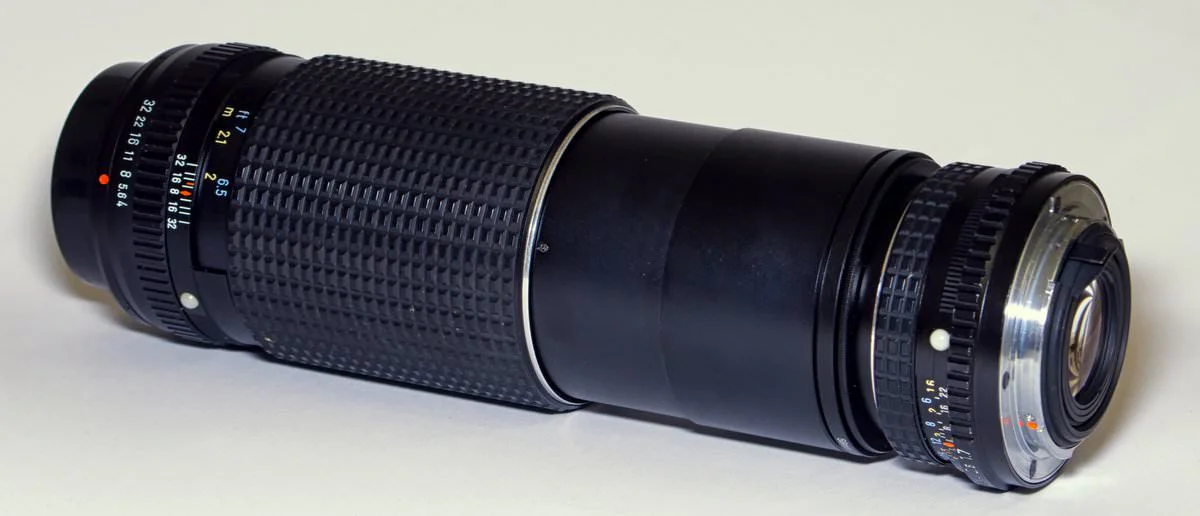
The full name is Pentax DAL 18–55 mm 1:3.5–5.6. It’s made for APS-C, so it doesn’t support full frame. Since I’ll use it reversed, I don’t know what it’ll do on full frame. I already expect edge degradation—i.e., loss of sharpness. Let’s see if there’s vignetting.
In normal use, the body sets the aperture via a lever. As with many modern lenses, there’s no aperture ring. So I wedged the aperture lever with a toothpick to roughly f/8. Generally, lenses behave well around f/8. As magnification increases, you’d open the aperture a bit more, but I won’t be able to be that precise here.

I used the lens on the Olympus 65–116 telescopic tube. It’s my standard part, so all the adapters were already mounted and ready. I kept the tube at its minimum length, 65 mm. I don’t want to go into microscopic magnifications. The lens already has a tough assignment—no need to push it further.

Reversed at 55 mm
I’m using natural light. Daylight from the window is diffused with white cloth, illuminating the head of our stag beetle. At 55 mm the shoot is comfortable. The magnification is 2.5×—a value that lets you set everything easily without fuss.

Since the light is a bit low, exposure is 4 s. No problem—I’m not afraid of long exposures. To preserve quality, I won’t raise ISO and continue at ISO 250. In 29 frames we cover the beetle’s depth.
At first glance it looks quite good—better than I expected, actually. But since I’d already seen Murat’s photos, I’m not too surprised. I know that you can shoot macro with a kit lens!

Let’s look closer. The center makes us smile. The kit lens performs really well in the middle—nothing seems missing. Colors, sharpness—everything’s in place. We also need to check the edges.

Here, I can almost hear the lens groaning. The 18–55 struggles at the edges. But let’s be fair—it’s made for APS-C. Falling apart at the full-frame edges is normal. The lack of vignetting alone is enough for me. If this were shot on APS-C—or, in other words, cropped 1.5× from the center—we’d cut away the bad parts and the remainder wouldn’t show as much. In short, 55 mm reversed isn’t ideal on full frame for this lens.
Reversed at 18 mm
Now it’s time to push the limits. We’ll set 18 mm and repeat. Depending on magnification and aperture, diffraction can creep in and hurt detail. So I try to open the aperture a bit to reduce diffraction, because with the 65 mm tube we’ll be at exactly 6.5×! We’ve moved up a league—this is where you’d normally use microscope objectives.
With higher magnification comes a greater need for light. Exposure goes up to 8 s. Still not bothered. I shoot 40 frames to finish the stack.

The lens does a good job again. While it’s no microscope objective, the photo is clean. This time I wasn’t expecting this much. Curiously, I dive into center and edge detail:

The center again looks clean and sharp, as expected. Being a touch softer than at 55 mm is perfectly natural. Now, the edges:

Now we’re talking! With the increased magnification, we’re clearly leveraging more of the lens’s strongest central optics. The high-quality region now fills the full-frame sensor. I don’t see edge breakdown. The kit lens manages to surprise.
Conclusion
Beyond these tests, I don’t think I’ll use the kit lens for macro again—but not because of image quality. It’s simply that I have stronger solutions for every magnification level.
In summary, if you want to start macro, don’t get lost in “Which lens should I buy?” or “Where do I begin?” questions. Start right away with a kit lens that almost all of us have. As we always say, what really matters is light control and honing your technique. And you can start that right now—with a kit lens.