Macro rail - Newport linear stage

In the previous post, we looked at what the focus stacking technique is. We talked about how, to complete sharpness in areas that are out of focus, we need to shoot many photos and shift the focus point a tiny amount each time.
If we’re shooting handheld, we rely a bit on luck and take plenty of shots, hoping to get sharpness in every region. But if we don’t want to leave it to chance, we need to work more controlled. For that we need a fundamental tool: a macro focusing rail.
Macro focusing rail

If you do a Google image search for “macro focusing rail,” you’ll find countless different products. Picking a suitable one among them is truly difficult.
To use a focusing rail, our camera must first be locked down (if we’re shooting handheld, we don’t need any of what I’m about to say). The camera must be fixed well and not rock back and forth when touched, otherwise we can’t talk about precision. Our lens should be focused at a fixed distance. If we’re using an autofocus lens, we need to switch it to manual. In auto mode it won’t listen to us and will focus wherever it wants, disrupting the sequential shooting.
In a focus stacking session, after each shot we will nudge forward a small amount using only the focusing rail while carefully maintaining the camera’s position. This way we shift the focus slightly forward each time, take a new photo, and continue until our plane of sharpness has moved past the subject. Instead of pressing the shutter by hand, we need a cable or remote release. If we press by hand, the framing will start to drift before the exposure finishes.
How much shift should we make with the focusing rail? If the subject is an insect, we focus on the part closest to us for the first shot. Maybe the nearest part of the antenna, maybe the nearest part of the eye—set the rail so that area is sharp and take the photo. For the following photos, we advance by shifting the rail. How much to shift depends on both our magnification and our aperture value.
In an earlier post I shared a table showing depth of field. I’m sharing it again.
| | f/1.7 | f/2.8 | f/3.3 | f/4.0 | f/4.8 | f/5.6 | f/8.0 | f/11.0 | f/16.0 | | 0.50X | 0.70 | 1.1 | 1.4 | 1.6 | 2.0 | 2.3 | 3.3 | 4.5 | 6.6 | | 1.0X | 0.23 | 0.38 | 0.45 | 0.55 | 0.66 | 0.77 | 1.1 | 1.5 | 2.2 | | 1.5X | 0.13 | 0.21 | 0.25 | 0.30 | 0.36 | 0.43 | 0.61 | 0.84 | 1.2 | | 2.0X | 0.087 | 0.14 | 0.17 | 0.21 | 0.25 | 0.29 | 0.41 | 0.56 | 0.82 | | 3.0X | 0.052 | 0.085 | 0.10 | 0.12 | 0.15 | 0.17 | 0.24 | 0.33 | 0.49 | | 4.0X | 0.036 | 0.060 | 0.071 | 0.085 | 0.10 | 0.12 | 0.17 | 0.24 | 0.34 | | 5.0X | 0.028 | 0.046 | 0.054 | 0.066 | 0.079 | 0.092 | 0.13 | 0.18 | 0.26 | | 7.5X | 0.018 | 0.029 | 0.034 | 0.041 | 0.050 | 0.058 | 0.083 | 0.11 | 0.17 | | 10X | 0.013 | 0.021 | 0.025 | 0.030 | 0.036 | 0.042 | 0.060 | 0.083 | 0.12 | | 15X | 0.0083 | 0.014 | 0.016 | 0.019 | 0.023 | 0.027 | 0.039 | 0.053 | 0.078 | | 20X | 0.0061 | 0.010 | 0.012 | 0.014 | 0.017 | 0.020 | 0.029 | 0.039 | 0.057 | | 30X | 0.0040 | 0.0066 | 0.0078 | 0.0094 | 0.011 | 0.013 | 0.019 | 0.026 | 0.038 | | 40X | 0.0030 | 0.0049 | 0.0058 | 0.0070 | 0.0084 | 0.0098 | 0.014 | 0.019 | 0.028 |
This table shows depth of field (DOF). When choosing step size, we pick a step slightly smaller than this depth so that each shot shares some of the same in-focus region with the next one. That way, when our software merges two frames, it can match the overlapping areas and process more accurately.
By leaving this overlap, we also give ourselves a bit of room for error. Engineering always calls for enough flexibility to compensate for a small calculation error in step size or a slight mistake while turning the rail.
Therefore, instead of using the DOF at the chosen aperture, we can select the DOF of the one-stop wider aperture as our step size. In other words, for a shoot at f/11, we can choose the DOF listed for f/8, or for a shoot at f/4, we can choose the DOF listed for f/3.3. I marked these two in red in the table to make them easier to find.
So, let’s look at the table. With a 1:1 macro lens shooting at f/11, we can get by advancing 1.1 mm per step on the rail, whereas at 5X magnification and f/4 we need a step size of 0.05 mm. As you can see, that’s a 22× difference. So, if we’re shooting an object of the same depth, in the second case we need 22 times more photos.
Thankfully, in practice it’s not like that. If we shoot a bee at 1X and stack the entire body depth, at 5X we can’t fit the whole bee into the frame anyway—say we’ll only frame the eye, and stack only across the eye’s depth. As the subject gets smaller, the depth shrinks too, and we won’t need hundreds of shots.
But the challenge remains. How are we going to make a 0.05 mm shift?
Which focusing rail should be chosen?
Rails that move only forward are sufficient.
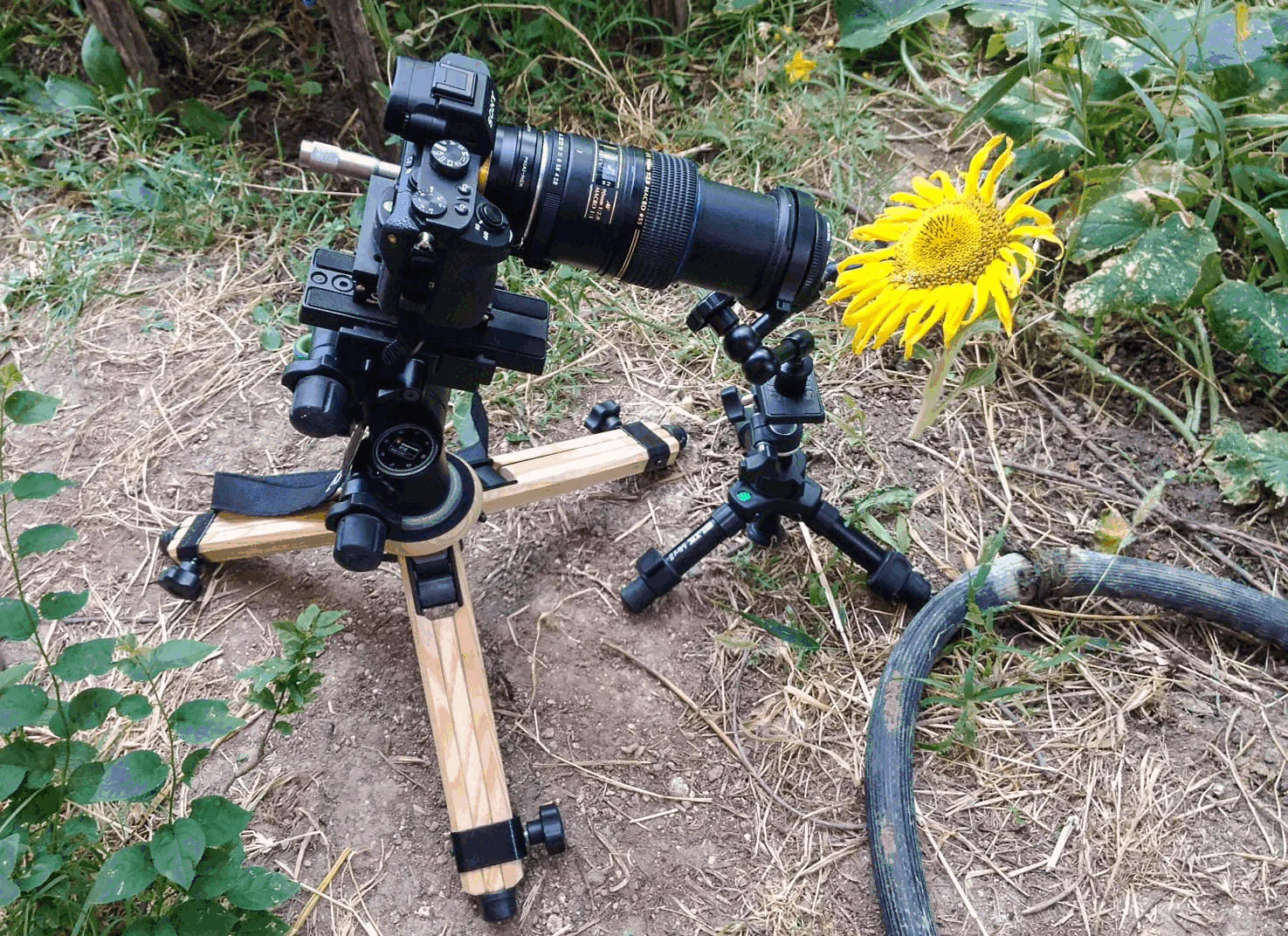
There are rails that, besides forward–backward movement, add left–right motion—and some even add up–down mechanisms, thinking “more features can’t hurt.” These rails often can’t bear load under lateral movement, sag to the sides, cause vibration, and ruin our framing. While we do need these movements, handling them at the tripod level with tripod heads (like the Manfrotto Junior 410) rather than at the rail level will yield a much healthier system.
A rail that provides only forward–backward movement with 0.05 mm precision is all we need. Instead of extra features, we should prefer the simple but precise one.
Chinese focusing rails
As with many devices when starting out, I first made the wrong move in choosing a focusing rail and tried Chinese products. Unfortunately, calling these “coarse rails” is being polite. The rotation screw diameter is kept small, so precise turning isn’t possible. Because the thread pitch of the rail is coarse, instead of a smooth continuous motion you progress as if riding a horse-drawn cart on a dirt road. While there’s a chance they work at around 1X magnification, they’re far from something I would recommend.
Macro bellows
If you have a good bellows, you likely already have a rail. Most bellows, in addition to the mechanism that sets bellows length, have a rail underneath that can move the whole system forward–backward.

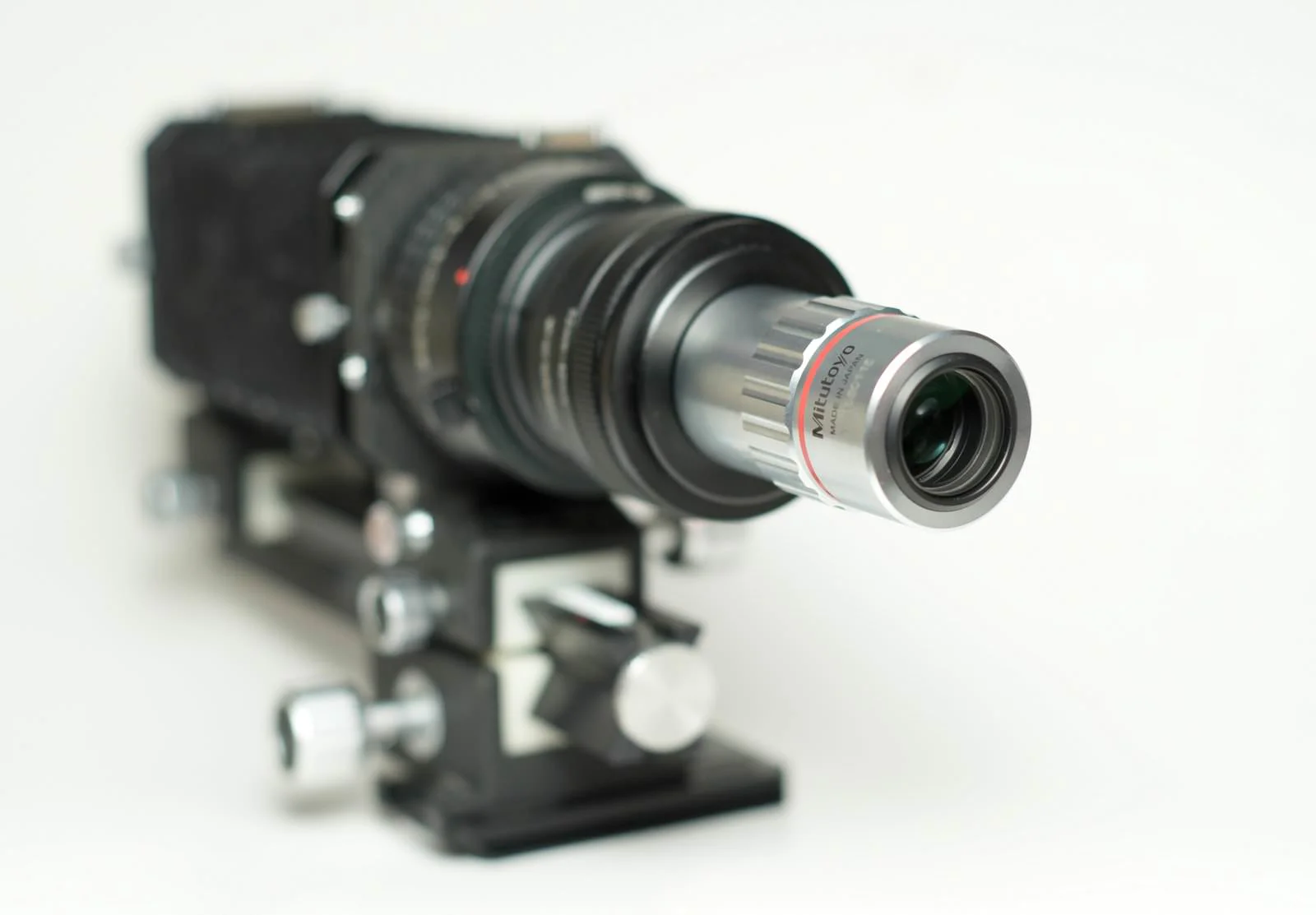
The Asahi Pentax bellows I use here is a fairly high-quality product. The motion on its rail is vastly more consistent than the Chinese devices. Thanks to this rail—and also stopping down a bit and accepting some quality loss—I was able to work up to 8X magnification with enlarger lenses.
But once you add in apertureless microfilm lenses and microscope objectives with far shallower DOF, my bellows rail became completely useless.
Microscope lenses and magnifications like 10X are so sensitive that if I lean a little on the stool I’m sitting on, it creates floor flex in the parquet that I normally can’t perceive. That motion, transmitted to the tripod and camera on the same floor, shifts sharpness on an ant’s eye by the width of a single ommatidium! In the focus-stacked result, that gap jumps out clearly. When I told a friend about this, he laughed at first—then was amazed after experiencing the same thing at home.
In situations requiring micron-level precision, the bellows rail is unfortunately insufficient. Let the bellows sit aside for now—let’s get to the solution that’s the subject of this post.
Newport Linear Stage
Two solid plates sliding over each other and a micrometer that controls the slide—that’s what this device consists of. On both the top and bottom plates there are many threaded holes to attach other gear. As you turn the micrometer, the two plates glide with astonishing precision and smoothness. So much so that when you turn the micrometer one full revolution, you might not even feel the advance.

The 423 and 433 are related. They feature a ball-bearing slide mechanism. My unit is the 423. This model offers about 25 mm of travel and a 15.8 kg load capacity. The 433, a slightly wider-surface sibling, can travel 46 mm with a 19.5 kg load capacity.
The 426 is somewhat different technologically. It has a different slide mechanism designed to carry heavier loads: a crossed-roller mechanism. It’s a bit more durable. It has 25 mm travel and a 33.1 kg load capacity. However, this increase also doubles the price.
There are two different micrometers for these products: SM-25 and SM-50. As the names suggest, they offer 25 mm and 50 mm of travel. Precision is the same for both: 1 micrometer (one hundredth of a millimeter) movement capability. There’s also an SM-13 I sometimes come across; with 13 mm of travel it’s inadequate for photography. SM-13 is outside our interest.
Newport Linear Stage – Camera and tripod mounting

I mentioned these products aren’t made for photography. In fact there’s an important difference among the models: all these models are produced in two types—metric and imperial (inch). The difference shows up in the threaded holes. Metric models have an M prefix. Like M-423.
The threads used in tripod systems are directly compatible with non-M (imperial) Newport devices. Both use inch measurements. The so-called “thin tripod screw” (1/4-20) fits these holes perfectly. My first Newport was the metric M-423. On metric models you just need to change the screws—use metric M6 screws instead of 1/4-20. You can find these at hardware stores. Since Turkey uses the metric system, they’re easy to source.
Prefer the 423 over the M-423
Still, if you can, choose the non-metric model. After a while, to keep a spare of this crucial part, I also acquired a standard (inch) 423. Since attachments are much easier, that’s what I use now—the M-423 sits as a backup.
We’ll mount the camera or bellows onto the Newport stage. For that, we need to attach an Arca-Swiss clamp on top of the device. Sunwayfoto is known for quality products. I’ll mount a clamp I got from them onto the Newport. There are cheaper solutions, but since we’ll entrust the whole system to this piece, it’s worth choosing a good one.


Not one, but two rails After all this about which rail to choose, I’m going to say you actually need two rails! Don’t get mad—here’s why.
You’ve set up and locked down the camera and roughly placed the subject in front of it. For lighting, you’ve surrounded it with a desk lamp, flash, a set of diffusers, reflectors, a background item, etc. Along the way your hands bumped here and there, things shook. Something’s position changed. You look through the viewfinder—nothing but a wide field of bokeh… Or the insect itself took a step forward or backward.
Or forget all that—you simply wanted to change magnification. You shortened or extended the bellows. The framing changed completely; the lens focused somewhere else entirely.
You can’t reacquire focus by hunting back and forth micron by micron with the Newport. It only has 25 mm of travel at most. We want to save that for focus stacking.
That’s why our system must also include a coarse rail. Preferably, we do this with the bellows rail. If we don’t want to use bellows, we need some other coarse rail. Even the poor-quality Chinese products I mentioned at the beginning will do—so long as they’re mounted solidly.
After using the coarse rail to roughly get in the ballpark, we fine-tune with the Newport to bring focus to the very front point where the focus stacking will start. Then the burst sequence begins.
Conclusion We’ve talked this much—how does it affect results? Let’s look at the two photos below. Click to open the larger versions for a better view.
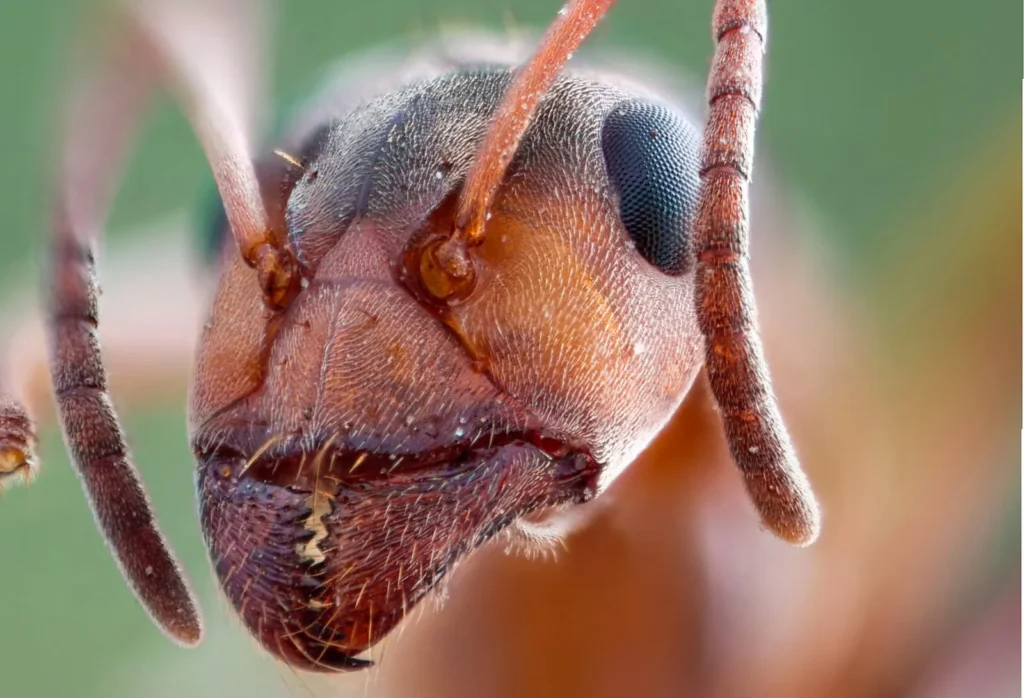

These are two photos of the same species of red ant shot at different times. The first was shot by shifting with the Pentax bellows. I genuinely struggled to make precise shifts. I ran two full passes, trying to make the smallest possible movement, hoping the second run would catch areas I missed in the first. Then I had to go back through all the photos to reorder them by focus position—figure out which is front, which is back—and rename accordingly. If I had exact duplicates of the same region, I deleted them. No matter how small I tried to move, and even though I shot twice, I couldn’t make the step small enough; in total I was able to get just 17 photos for the ant’s face.
When I shared the first photo on Flickr, I captioned it “a hopeless effort.” Since I didn’t get what I wanted the first time, I reshot this ant after I got the Newport. Because the Newport offers more than enough precision, this time I very easily—and with comfortable turns rather than tiny tweaks—captured 170 photos. The count is high because I included not only the ant’s face but also the body. But what I want to stress is that this was easy and error-free.
To perceive the difference more clearly, let’s zoom into parts of the ant’s face in both photos. In the marked areas we can see skipped, out-of-focus zones caused by uncontrolled shifts with the bellows.


I think the difference is clear. So where do we find these Newports? The three of us bought a total of five via eBay. We had to track and wait about three months. They’re not easy to find. And when they do pop up, the prices vary each time. On average I’d say around $200. Since it exceeds the customs limit, your order will likely be held at customs and you’ll need to go pay the tax and pick it up.
We couldn’t find brand-new Newports. We wrote abroad; no response. There’s no retail in Turkey anyway. Aside from ours, I don’t know if there are any in Turkey. After this post was published, many friends showed interest—some have probably acquired them.
Lastly, I want to emphasize that this isn’t the only solution. You can use any solution that provides micron-level motion in a similar way. As an alternative to the fully manual Newport featured here, there are also computer-controlled, fully automated rail solutions. Brands like StackShot and WeMacro offer devices that can carry out the entire capture process automatically from start to finish. Those who can afford the price difference may opt for these as well.