Dual-lens – Reversed lens on lens
You’re into macro photography and want to try something different…
You’ve got lenses of various focal lengths in a drawer: 200mm, 135mm, 90, 50, 35, etc. Or at least let’s say you have a short/medium tele and a standard lens.
If you don’t have a 1:1 macro lens, or if you want to shoot high-magnification photos above 1X, methods like tubes, bellows, and reversed lenses are more common. But if you want to do the same thing with near-zero investment, don’t skip trying dual-lens use. With this odd-looking coupling technique, you can get surprising results.

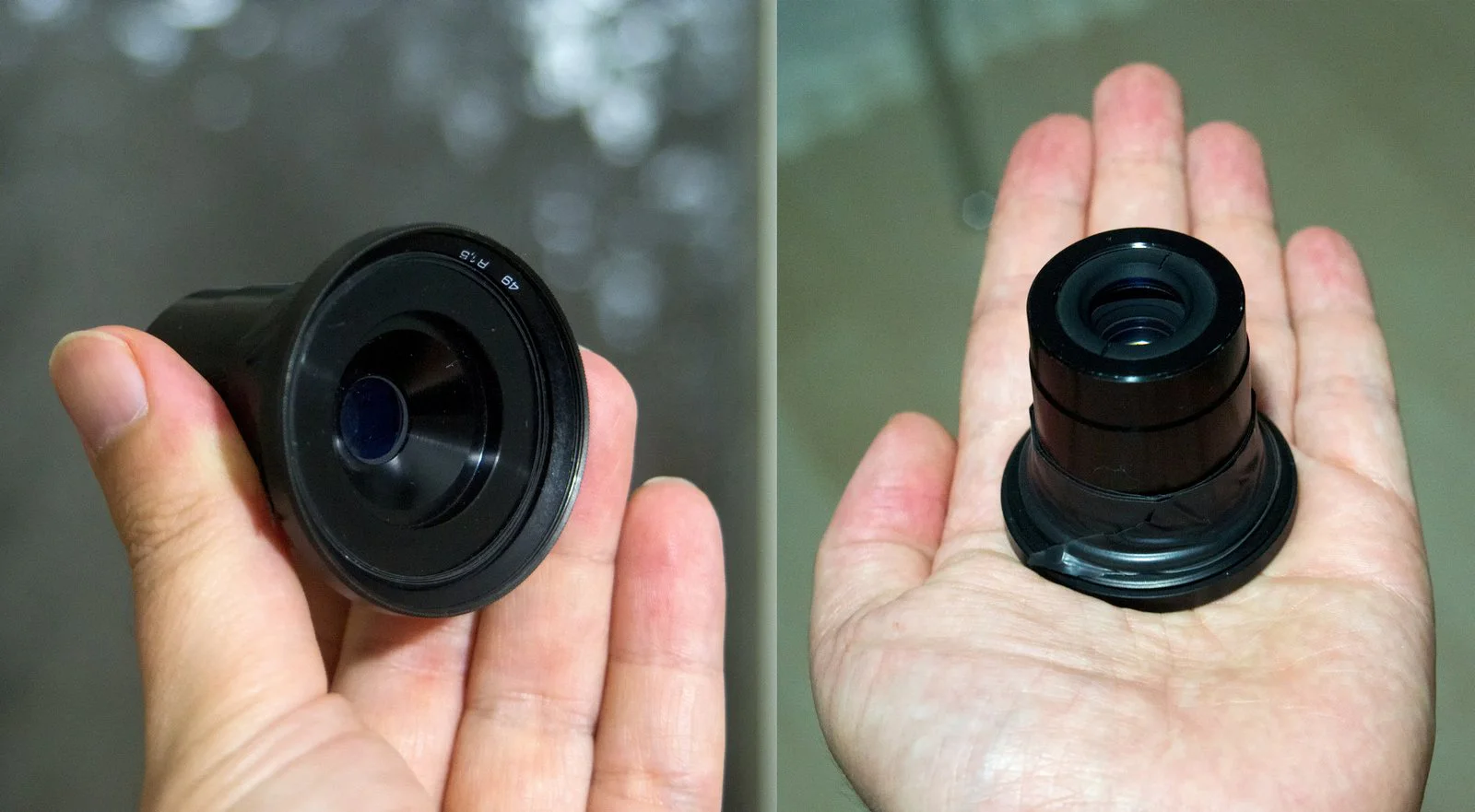
The only thing we need is a filter-to-filter adapter ring used for mounting a reversed lens onto another lens. You can find one for just a few dollars.
Step-up / step-down filter thread adapters

As for the filter-to-filter adapter, I only have one that connects 49mm to 55mm. I chose those sizes to couple often-used Pentax lenses like 50mm or 28mm onto the Tamron 90mm. As you might guess, those lenses have 49mm filter threads.
If I want to connect different lenses, instead of buying a separate adapter for each, I can use the cheaper thread-conversion rings to bring all the different diameters to 49–55, and then couple them with this single adapter.
These sets will help in other tasks too. For example, when applying the cross-polarization technique, we’ll need thread converters to use a single polarizer on all our lenses. For a post on cross polarization, follow this link: /en/capraz-polarize-filtre-teknigi-ile-makro-fotograf/
Which lenses are suitable We need to pick two lenses for the setup. When deciding which pair is suitable, we should consider a few things.
Sharpness
Since we’re using two lenses, we’re putting twice as much glass in the path as usual. That means each layer will steal a bit of sharpness and light transmission. Don’t be intimidated, though. If your lens collection is broad, choose the sharper ones. Prime lenses generally give better results than zooms. If you don’t have primes, just use whatever you have—simple as that.
Focal length – Magnification
The ratio of the lenses’ focal lengths matters—it determines the magnification. Roughly, the math is this: add the ratio of the two lenses to the magnification given by the long lens alone.
So, if we have a 100mm 1:1 macro lens, it gives 1X by itself. When we mount a reversed 50mm on the front, we add extra magnification of 100/50 = 2X. In total, we get 3X.
Aperture
The reversed front lens should be wide open. In other words, it needs to be a fast lens with a large maximum aperture; otherwise we may encounter heavy vignetting. If you’re using a full-frame body, vignetting will show up more readily.
If vignetting still occurs even with the front lens wide open, there are a few things we can do:
- Swap the rear tele lens for a lens with a shorter focal length.
- Use a front lens with a larger maximum aperture.
- Use a front lens with a longer focal length.
- Stop the rear lens down a bit more.
Examples of reversed lens on lens This time I didn’t want to drown the work in calculations by measuring with graph paper. I’ll jump straight to sample shots. We’ll judge magnification by eye through comparison. Speaking of comparisons, as usual let’s start with a photo shot at 1:1 with the Tamron 90mm.
Our guest will be a rose leaf from the garden and a live aphid on it. Aphids are so small that even a true macro lens at 1:1 can’t handle them alone. To fill the frame, you need microscopic magnifications like 10X. Let’s see how they look at 1X.

At 1X, it’s quite insufficient for seeing details. But at f/11 the depth of field is just right—we can see the entire insect sharply.
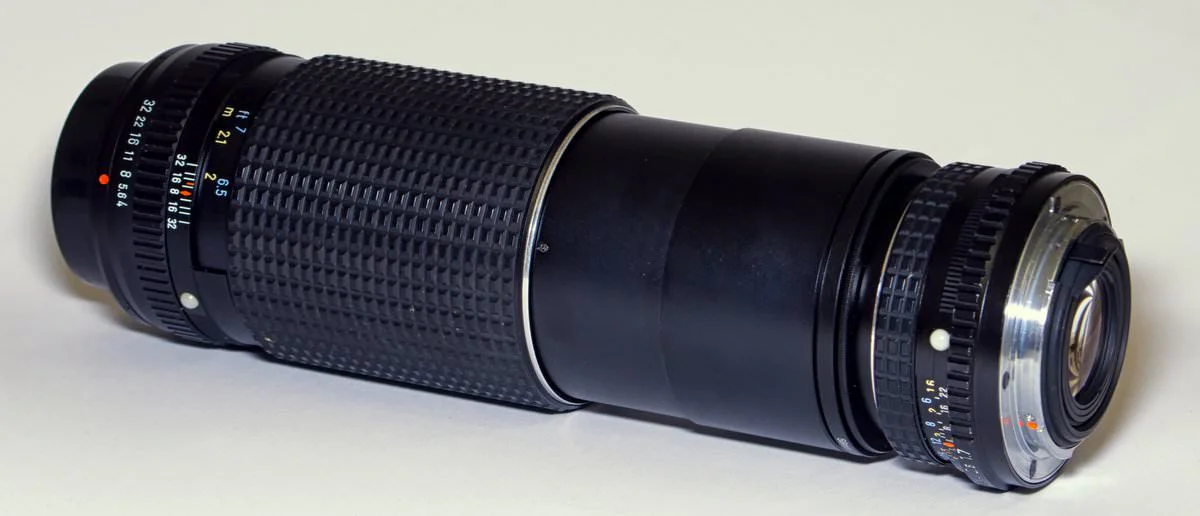
Pentax K 200mm f/4

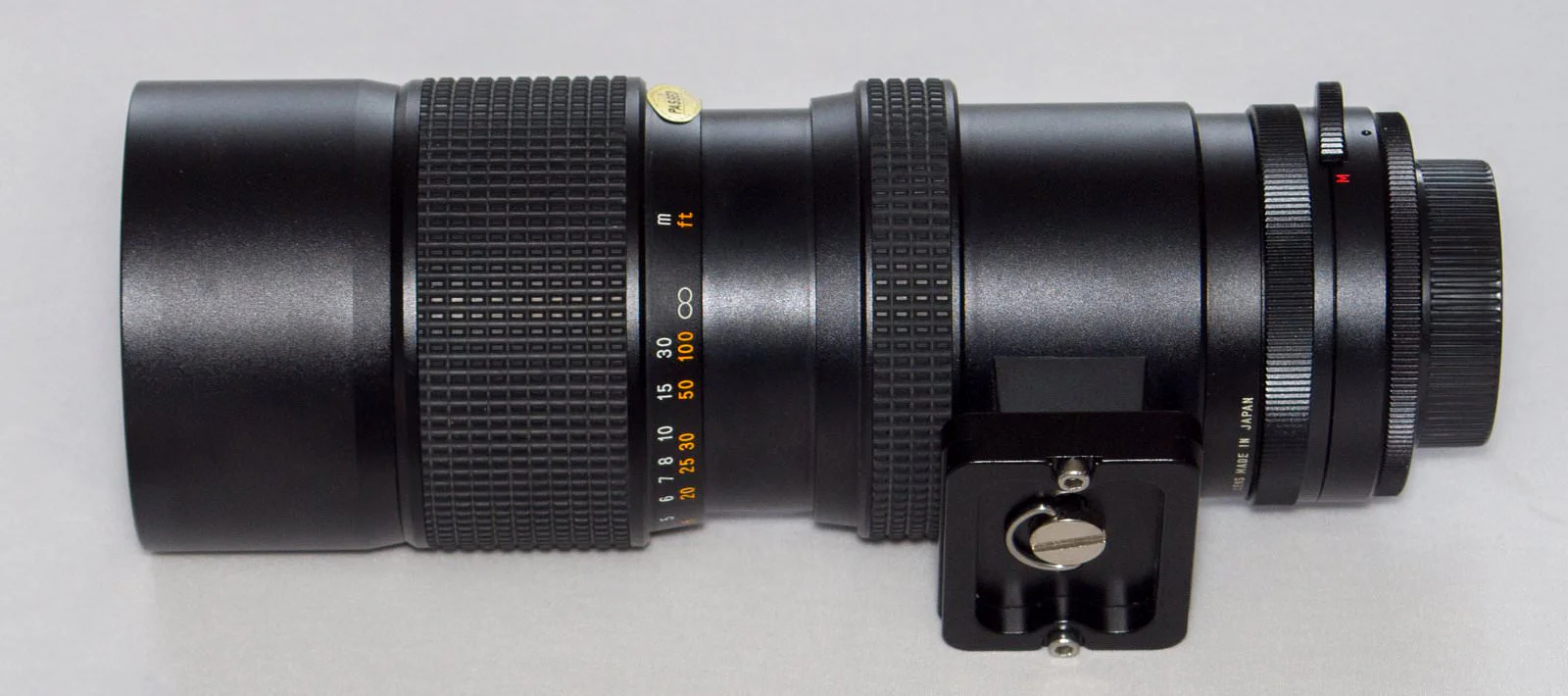
Since it has a 58mm filter thread, I first mounted a ring to step it down to 55mm, then added the 55–49 reverse coupling adapter. The reversed lenses I’ll test—Pentax SMC M 50mm and Pentax SMC M 28mm—both have 49mm filter threads.
Reversed Pentax M 28mm on Pentax K 200mm When we focus the K 200mm to its closest distance and add the reversed lens, this is what the setup looks like. It seems a bit long and unwieldy. In the photo below there’s a 50mm on the front, but it’s the same size as with the 28mm. Mounting the 28mm looks exactly like the shot below.

I wanted to try the highest magnification first, so I started with the 28mm. I’m expecting around 7.5X. That’s quite high, and I don’t have much hope—but let’s see the results.

The magnification is very high, but as I guessed, the result is terrible. Even at the 28mm’s widest aperture of f/2.8, vignetting wasn’t prevented. To compensate a bit, I stopped the 200mm down to f/16, which still didn’t eliminate the vignetting and, due to diffraction, killed the detail. The photo looks like watercolor. The K 200 and M 28 can’t be used together.
Reversed Pentax M 50mm on Pentax K 200mm The SMC M 50mm, being f/1.7 and having twice the focal length of the 28mm, suggests it won’t vignette. If we open up the 200mm a bit and use it at f/11, we can reduce diffraction-related sharpness loss.
Let’s see what we get.

Magnification should be close to 5X. Compared to the 28mm, we obtained better image quality. With focus stacking, we might produce something usable. Still, it’s below the quality I find acceptable. Perhaps the K 200mm isn’t sharp enough. Let’s try the Pentax K 135mm f/2.5, famous for its sharpness.
Reversed Pentax M 50mm on Pentax K 135mm The K 135mm paired nicely with the Raynox and gave us lovely macros. Since the reversed 50mm works in a similar fashion, I think it’ll do well here too.

This time it looks like we’ve hit a reasonable magnification and again a reasonable quality. We can even compose a frame that gives our aphid some breathing room.
The magnification came out around 3X. If we’re shooting handheld, we shouldn’t exceed this ratio. Naturally the depth of field isn’t sufficient. We’ll need to shoot a few extra frames and complete the out-of-focus areas on the computer.
Conclusion In the sample shots, to increase depth of field a bit I kept the aperture around f/11. Given the magnification level, that’s too stopped down and caused loss of detail. In similar systems, if you can avoid vignetting, you could shoot the main lens around f/5.6 and use focus stacking to get sharper photos.
There was another lens I wanted to include as the reversed lens in this post: the Nikon El-Nikkor 50mm f/2.8N. I was sure it would produce much sharper images than the Pentax 50mm. But the 40.5mm–49mm thread converter I used on that lens and the PK reverse adapter got stuck together. After pushing it until I cut my hand, I gave up. You can’t expect great workmanship from no-name Chinese adapters. Another time, then.
My personal opinion is that the dual-lens technique isn’t a method to favor. At least with the lenses I have, I can’t approach the quality I want. If you have to, it’s fun to try—but it doesn’t come close to the quality of photos shot with a reversed lens on extension tubes. Your best bet is to get a good set of extension tubes :) And continue reading from the reversed lens article.