If you don't have a macro lens, use a daily lense for close-up shots

We have a camera, and we want to shoot macro photos.
Where do we start? Can’t we do something with the equipment we already have without spending money? Or is it essential to buy a 1:1 macro lens?
In fact, moving into a completely new field without any expense is hardly possible. But it’s certainly possible to crack open the door to the macro world at the lowest cost. Most of us have lenses at various focal lengths. However, most of them have minimum focusing distances that are quite far from macro territory. Shooting from about half a meter away, we can’t get the detail we want. From that distance, we may not even be able to tell what the tiny subject we’re trying to capture actually is.
In this article, let’s look at how we can use the lenses on our compact digital or SLR camera for close-up work. For each method we’ll briefly touch on here, you can find more detailed review articles here as well.

- Close-up filters
- Extension tubes – bellows – helicoid
- Reverse mounting
- Reverse lens on top of another lens
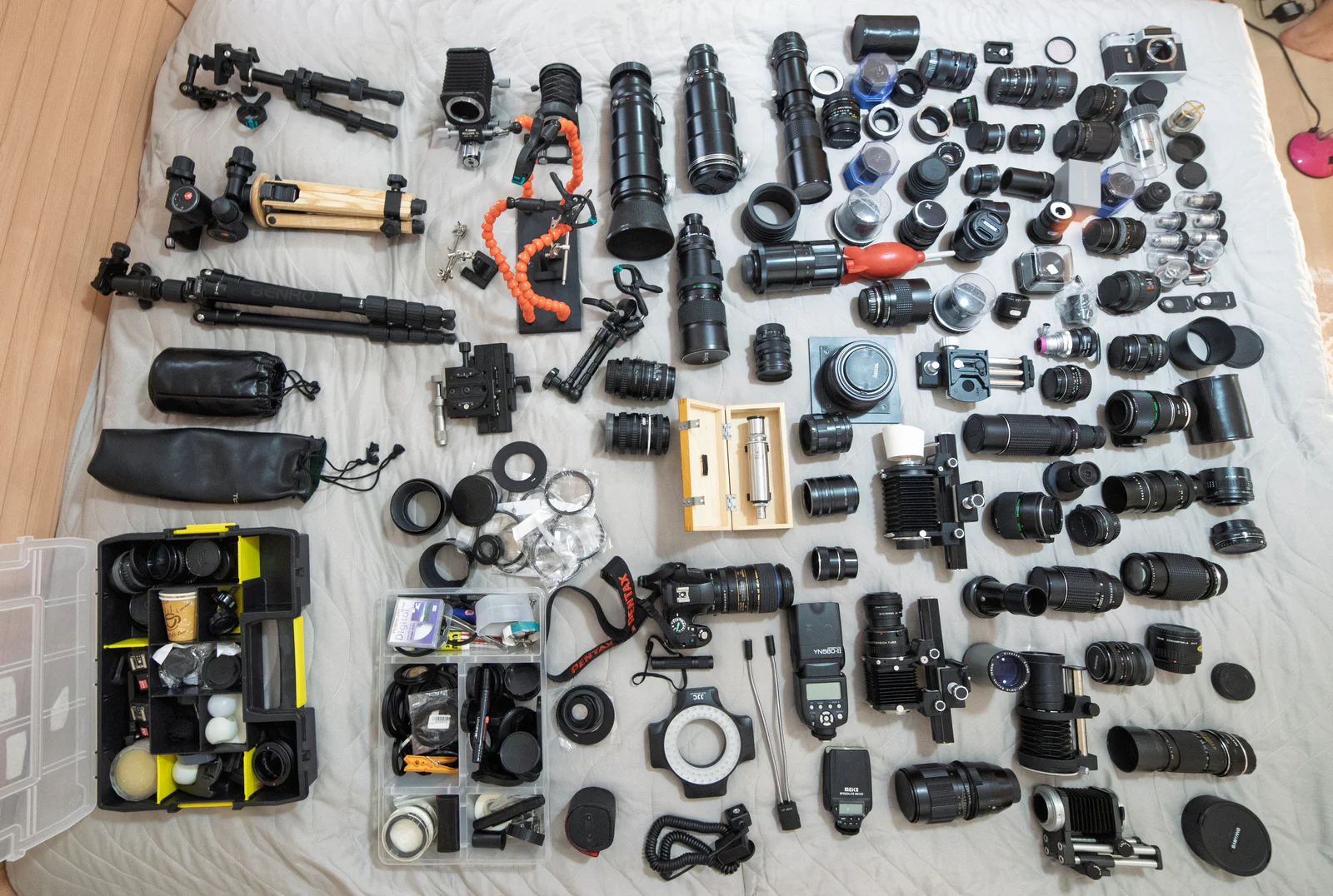
On SLR cameras, we can use these four either separately or together. Considering the variety of lenses we may have, there are quite a lot of possibilities to try. Some will deliver satisfying results; some may be a bit forced. I’ll describe things mostly as I’ve tried them myself.
Close-up Filter

The reason I put close-up filters first is that they have a broad range of use. Whether we have an SLR or a compact camera—whatever our lens is—we can use these with a suitable adapter and have a chance to shoot macro.
You can think of a close-up filter as a magnifying glass. By attaching this magnifier in front of our lens, we gain the ability to shoot from closer distances. With a close-up filter attached, we can even tweak the magnification ratio by changing focus on the lens.
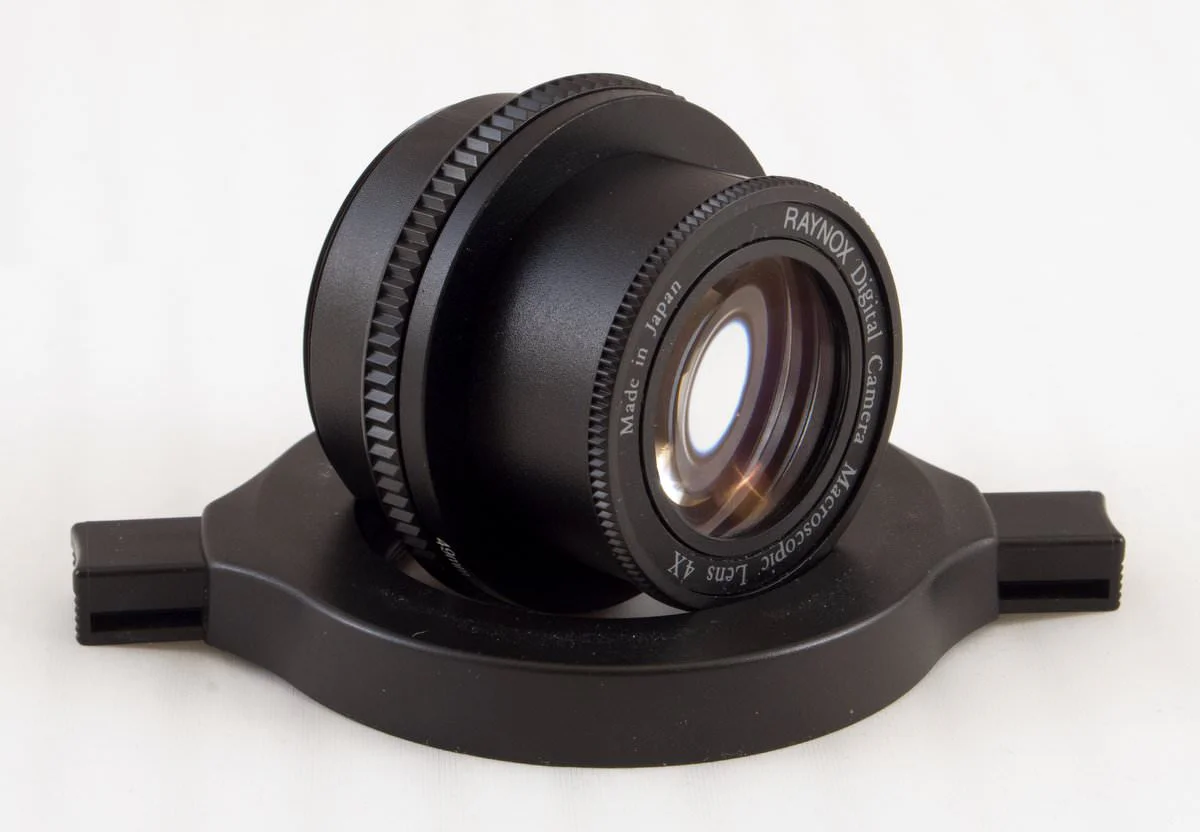
You can find many close-up filter models with different magnification options under various brands. Products of the same brand (or of another brand via an adapter) allow stacked use. I’ll give an example from the Raynox DCR-250 model, which I own.

Raynox units come with an adapter. There are different adapters depending on the lens’s filter diameter. Mine is a universal adapter that can be attached to lenses in the 52–67mm range. If that’s not enough, by obtaining adapters with the appropriate filter diameter, we can also use Raynox with our compact digital camera. Compacts already focus quite close and are decent at macro. Raynox lets us improve that further.
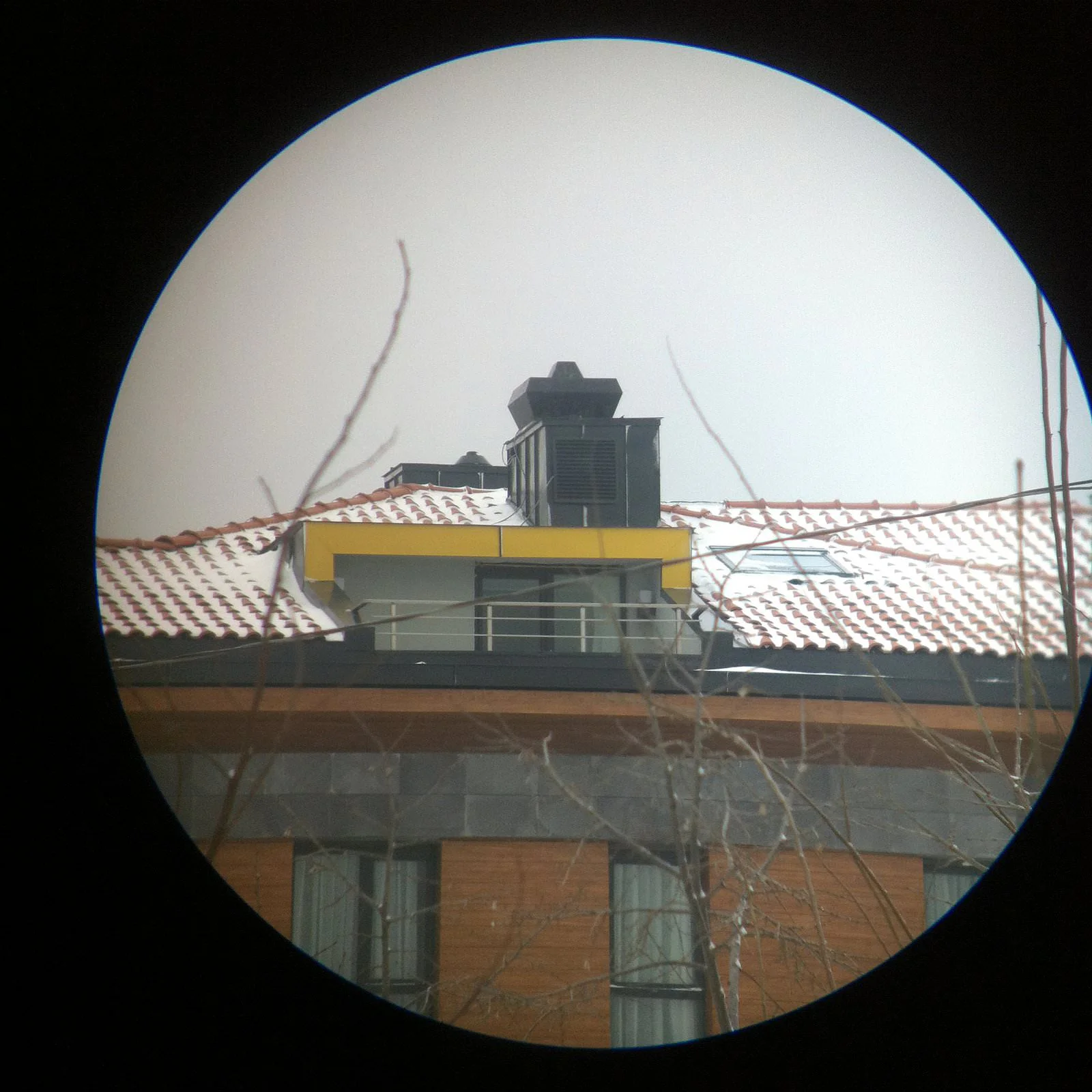
I did a small test with a Pentax K-series 135mm f2.5. Without the Raynox, this lens can focus no closer than 1.5 m. Below are the before and after images without and with the Raynox attached.


It may sound surprising, but what enables this is that our lens is now focusing much closer. In other words, instead of 1.5 meters, we can now shoot from just 10–15 cm. Different lenses at different focal lengths will yield different results. As I said, I’ll provide examples and measurements in other articles.
You can find a detailed review for Raynox’s two models, DCR-250 and MSN-202, at the following address:
/en/raynox-dcr-250-msn-202-close-up-filtre/
Extension Tubes, Bellows, and Helicoid in Macro

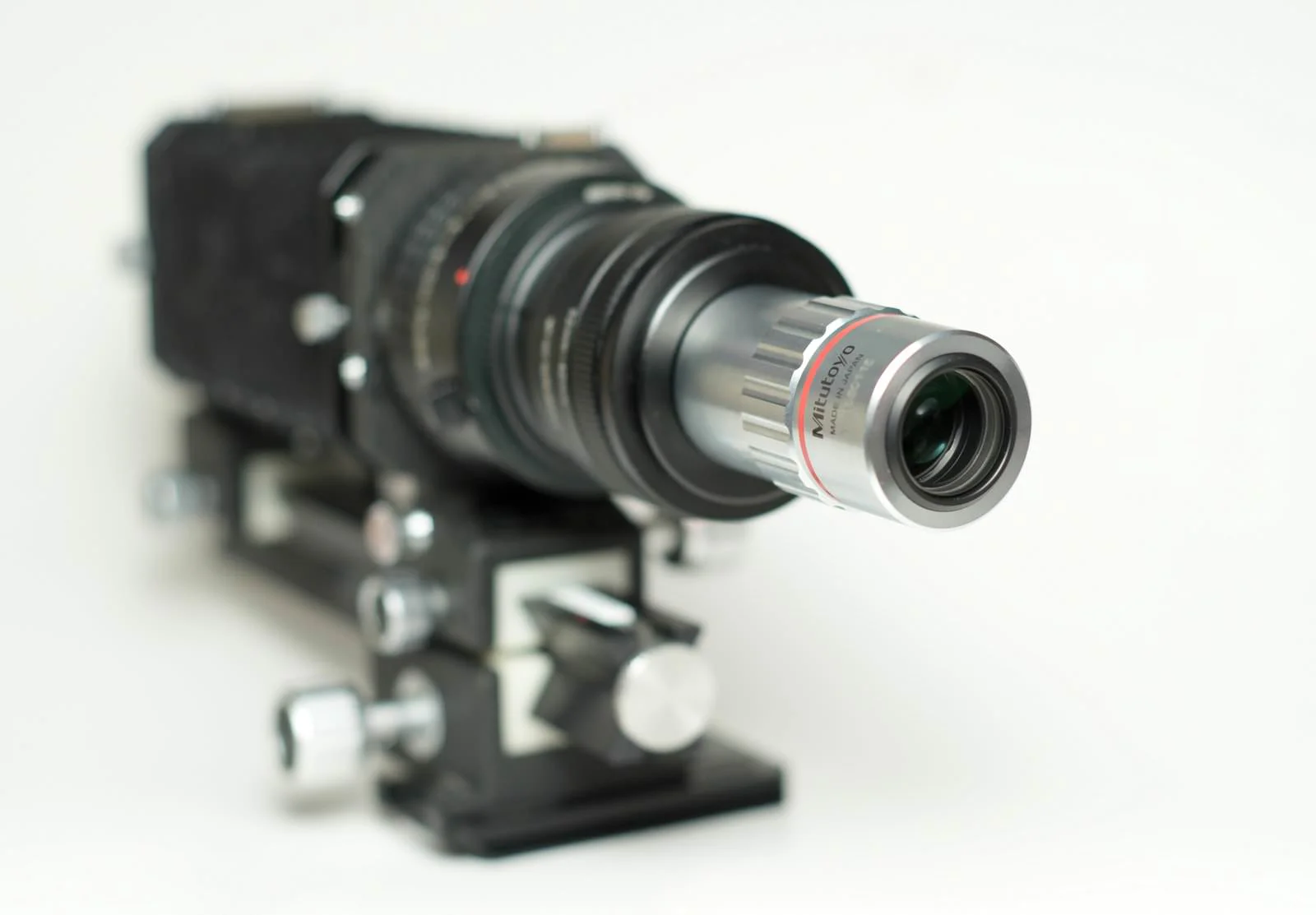
Tubes, bellows, and helicoids are basically the same thing. These accessories, which are light-tight empty tubes with no optical elements, force our lens to focus closer. Tubes are structurally very solid, but because they’re fixed-length we can’t finely change framing and magnification—whatever the tube length is, that’s what you get. Bellows, unlike tubes, have an extendable, collapsible structure. We can tweak magnification and framing as we like. Also, because bellows can extend a lot, they can reach high magnifications. A helicoid is a helper that combines the sturdiness of a tube with the flexibility of a bellows—the same mechanism as in our zoom lenses. These are tubes whose length can be changed by turning or pulling.
Since none of these contain glass elements, they don’t degrade image quality, but they aren’t as tiny an add-on as a close-up filter. For handheld outdoor shooting, a Raynox is a much more compact and lightweight solution. When setting the length of the tube or bellows we’ll use, we look at our lens’s focal length and how much magnification we want. Shorter tubes are used at wide angles, and as we go toward telephoto, longer tubes become necessary. That’s why tubes are built in sections; we get the desired length by stacking them. To keep things portable and practical, tubes are often used together with wide-angle lenses (reversed). Otherwise, we may end up needing a tube so long and unstable that handheld shooting becomes impossible. There are folks who try this just for fun:

When buying a tube, the key point should be choosing a branded, quality product. There are very cheap Chinese tubes on the market. I bought one just to try. But it didn’t fit the camera body properly. Because it risked jamming the bayonet and causing damage, or dropping the lens attached to it, I didn’t use it much. That’s a risk not worth taking for a little savings. Also, these tubes lack designs that prevent internal reflections—something that would negatively affect sharpness/contrast. We have an article explaining how important this is:
/isigi-evcillestirmek-makro-cekimde-ic-yansima-ve-kontrast-sorunlari/

Although it’s usually not crucial since we will generally mount lenses reversed onto the tube, quality tubes can offer automatic aperture and even autofocus support. Thus, if we’ve mounted automatic lenses in the normal (non-reversed) way, we get a chance to control aperture and focus from the body. With auto-aperture tubes used together with automatic lenses, we can shoot without viewfinder darkening: the aperture stays wide open until the moment of exposure and closes with the shutter.


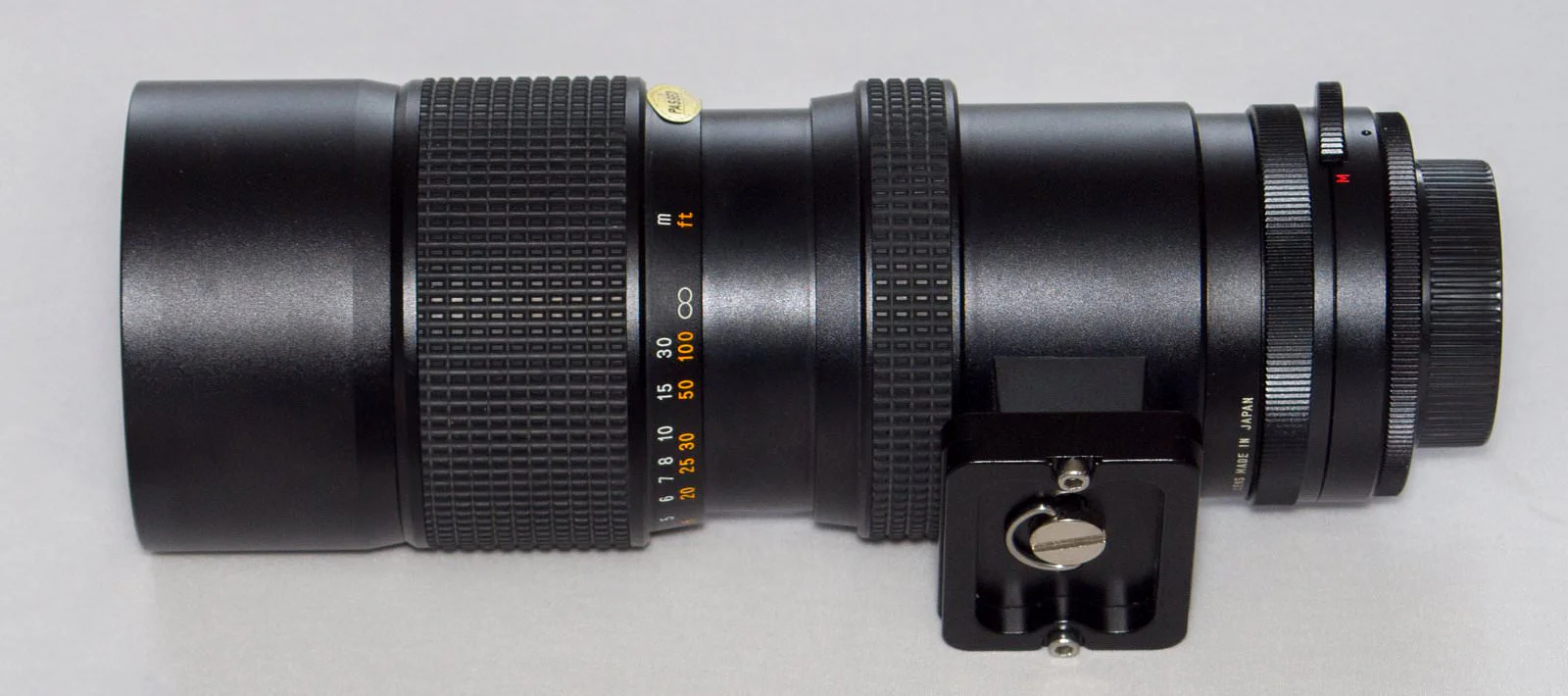
An interesting use case for tubes is with telephoto lenses. If you shoot birds, you know that with long teles you can’t focus closer than 4–5 m. If the bird that always flies away lands right next to you one day, your thousands-of-dollars lens will be in your hands while you just watch :) In this situation, by attaching a thin tube you can sacrifice infinity focus and choose to work in the 2m-50m range instead of 4m-infinity. I think this is quite reasonable. A bird farther than 50 m won’t be close enough even with the strongest lenses. For this kind of shooting, autofocus support on the tube will be important. For macro shooting, AF support is not necessary.

Among the best-quality products we can get as a helicoid is the Olympus 65-116. You’ll need additional adapters to mount the body and the lens, and since it has a tripod collar, it lets you shoot easily in horizontal, vertical, and in-between orientations.
You can find a detailed review article on using tubes here:
/en/makro-uzatma-tupu-ile-makro-fotograf-cekimi/
Reverse Lens Mounting

When our lenses are mounted in reverse—something they were never designed for—they start to focus very close. I mentioned this in my first article. When I was in middle school, I was playing with my binoculars; when I looked through them backward, everything looked very far away. In that position, when I looked not around me but very close—at my fingerprint—I discovered it magnified things like a microscope. I remember being scared when I looked closely at a cut on my finger like that.
For reverse mounting we use the filter thread of our lens. Normally we screw filters onto this like a thread. There are adapters that use this thread on one side and fit our camera mount (bayonet) on the other. We call these reverse mounting adapters. They’re tiny and cheap—just a few dollars. Most don’t have any markings. So pay $1 more and get ones that actually say what they are. Otherwise, after a while you’ll be rummaging through overflowing drawers wondering “which ring was for connecting what”.
We don’t mount the reversed lens directly on the camera, but onto a tube whose length we’ve decided on in advance. Bellows or a helicoid will also work, of course. This way we can do the high-magnification shooting called “extreme macro”. The most preferred everyday lenses for reverse mounting are 28mm and 50mm. Besides these, enlarger lenses are almost always used reversed in macro.
Note: Don’t reverse-mount zoom lenses; because the zoom mechanism isn’t built to support the lens when carried from the front, it may be damaged. I know because it happened to us :)
For a detailed review of the reverse mounting technique, click the address below:
/ters-lens-baglama-teknigi-ile-makro-fotograf-cekimi/
Reverse Mounting a Lens onto Another Lens


No matter how odd it sounds, macro shooting is very open to experimentation, so people do things like this. What we’re actually doing is: if we don’t have a close-up filter, we use another lens that, by the same principle, acts as a strong magnifier in its place. First we mount a normal tele lens on the camera. Then, using a special ring that connects filter thread to filter thread, we mount a second lens reversed onto it. For example, if we have a 200mm tele lens with a 52mm filter diameter and a 50mm lens with a 49mm filter diameter, we use a product called a “49mm–52mm filter-to-filter adapter” to reverse-mount the 50mm onto the 200. Another name for these adapters is “macro coupling adapter”.
If you use a zoom lens as the main lens, you’ll find a very flexible setup by changing magnification through the zoom range.
It’s said that to find the magnification amount, we add the base magnification of the main lens to the ratio of the two focal lengths. For example, if a 90mm macro lens gives 1:1 and we mount a reversed 50mm in front, 90/50 = 1.8×, so in total about 2.8× magnification. However, in practice, the focusing distances of the lenses used matter. I’m not entirely sure—I measure the magnification to find out. In the example at the very bottom, you can see that the magnification is quite high when 90mm and 50mm are used.
You can also find this topic detailed in a separate article:
/cift-lens-lens-uzerine-ters-lens/
The last thing I’ll say is this:
If we take the methods I’ve described as being solely for doing macro with non-macro lenses, that would be incomplete. All these methods give excellent results when used on lenses designed specifically for macro, i.e., true macro lenses, special-purpose macro lenses, and enlarger lenses. If you have a macro lens, try it with these methods as well. You won’t regret it :)